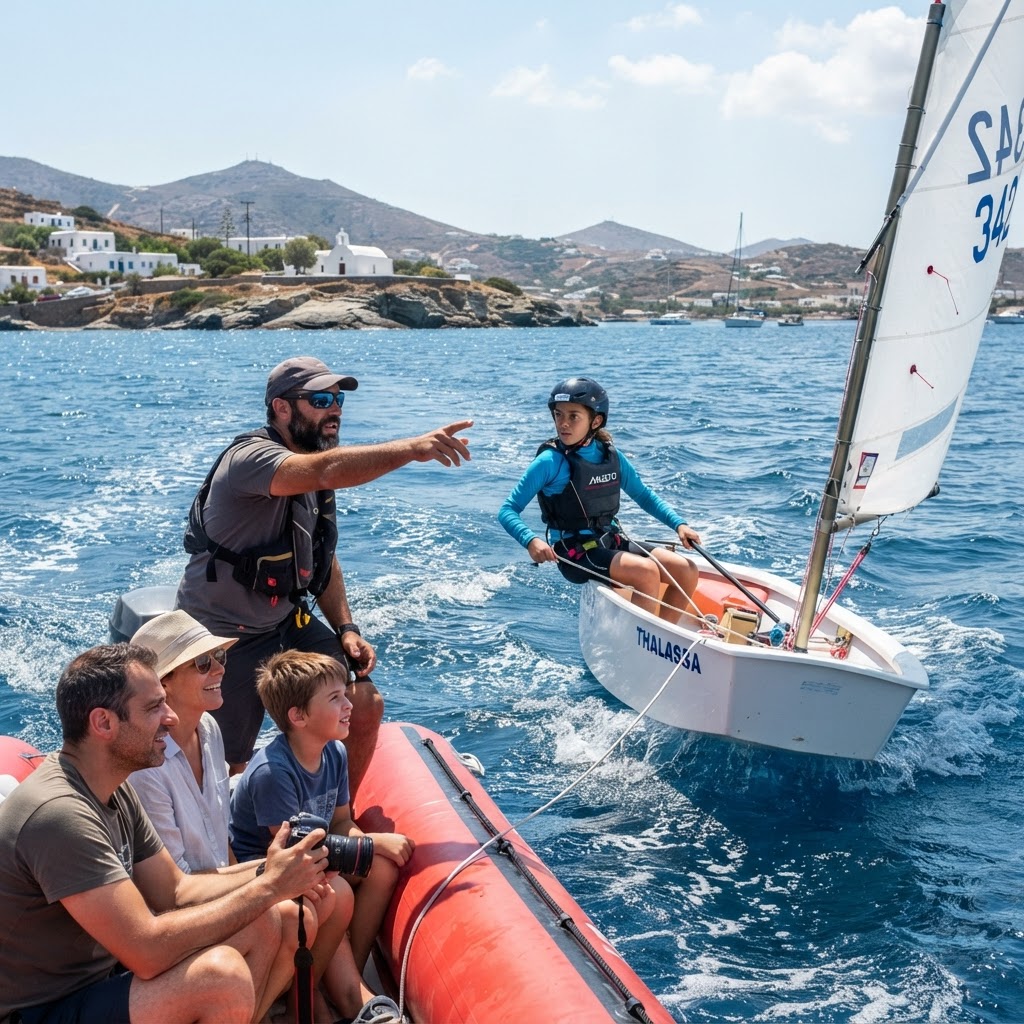
For the sailor, the wind is not invisible. It leaves traces everywhere — on the surface of the water, in the clouds, on flags, on the sails of other boats. The ability to "read" these traces is perhaps the most valuable skill in sailing — the one that separates a good athlete from an exceptional one. And it can be learned. ## The water: the wind's mirror The first source of information is the sea itself. Where the wind blows harder, the surface darkens and becomes "ruffled" — gusts (puffs) appear as dark patches moving across the water. Conversely, bright, smooth areas (lulls) mean less wind. An experienced sailor is constantly looking toward the direction from which the wind is coming to see what is "coming down" toward them in the next few minutes. ## True and apparent wind One of the first "clicks" in a sailor's mind: the wind you feel on a moving boat (apparent) is not the same as the actual wind blowing (true). The faster you move, the more the apparent wind "shifts" toward the bow and increases in strength. That is why sails are trimmed differently at every speed — and why sailing can never be learned just from books: the body must feel it. ## Changes in direction: shifts The wind never blows steadily from the same direction — it "oscillates" a few degrees left and right, constantly. These small changes (shifts) are the "currency" of racing: whoever utilizes them correctly gains ground without necessarily going faster. When sailing upwind, the rule is simple in theory and difficult in practice: you sail on the tack that "lifts" you toward the goal (lift) and you tack when the wind "knocks" you (header). ## The signs around you Beyond the water, the sailor reads: flags and trees on land, the sails and heeling of other boats (if the boats in front of you heel suddenly, you know what is coming), the clouds that portend strengthening or changes, and even the birds flying low. In an Optimist, the most direct tools are the telltales on the sail and the wind indicator at the top of the mast. ## How children learn it In sailing clubs, reading the wind is taught through games and observation: "where is the wind coming from now?", "show me a gust on the water", "what will the wind do in ten minutes?". Over the years, this observation becomes instinct. In the waters of Artemis, with the steady thermal breeze of the South Euboean Gulf, the children of NOAS have an ideal "laboratory" to practice it all year round.
Frequently Asked Questions
Why is the wind "visible" on the water?
Wind gusts ripple the surface of the water and change the way it reflects light — that is why areas with more wind appear darker and "ruffled," while lulls appear brighter and smoother.
What is apparent wind?
Apparent wind is the wind perceived by a moving boat: the combination of the true wind and the "speed wind." Sails are always adjusted based on the apparent wind, not the true wind.
What are telltales?
Telltales are thin pieces of thread or fabric on the sail that show whether the air is flowing correctly over it. When they "fly" smoothly on both sides, the sail is trimmed correctly.
Can anyone learn to read the wind?
Yes — it is a matter of practice, not talent. With systematic observation during every training session, reading the wind gradually becomes instinct — even for children aged 8-10.
Related Articles
Ready to start sailing?
Join NOAS Sailing Club at Limeniskos Artemidas (Artemida small harbour) — lessons for all ages and levels.