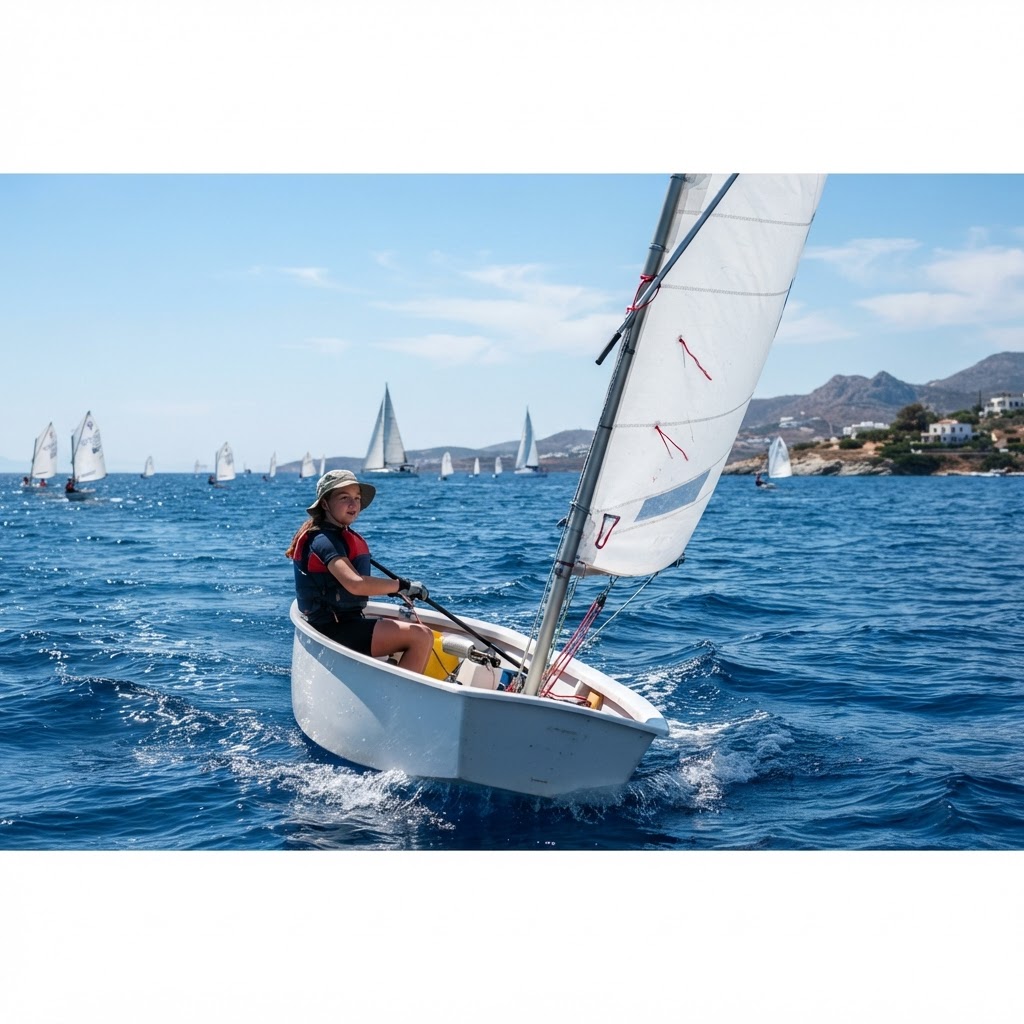
Introduction: The Invisible Language of the Wind
Sailing is often described as a chess match on water. For young sailors in the Optimist class, the board is constantly shifting. At the Nautical Club of Artemis and Spata (NOAS), located in the unique environment of the South Euboean Gulf, our young athletes learn that to sail fast, one must first learn to read the invisible language of the wind. Understanding the difference between a steady breeze, a puff, and a lull is what separates a recreational sailor from a competitive tactician. In this guide, we explore how to interpret the water and the wind to maximize your performance on the racecourse.
Understanding the Dynamics: Puffs, Lulls, and the Sea State
Before we dive into technical execution, we must define our vocabulary. A 'puff' is a sudden increase in wind speed—a localized area where the wind intensity is higher than the surrounding flow. Conversely, a 'lull' is a dip in pressure. For an Optimist sailor, a puff is an opportunity to generate extra speed, provided the boat is trimmed correctly. A lull, however, requires a more conservative approach to sail shape to keep the boat moving through the water without stalling.
In the Euboean Gulf, where thermal winds are common, these variations are rarely random. They are often triggered by the topography of the coastline or thermal activity over the land. Learning to 'see' the wind on the water's surface is the primary skill of a junior sailor. You aren't looking at the wind itself; you are looking at the 'cat's paws' or the darkening of the water's surface that indicates a breeze is approaching.
Reading the Wind on the Water
How do you spot a puff before it hits? It starts with observation. As you scan the horizon, look for texture changes on the surface. A puff will appear as a localized disturbance, often darker in color because the surface is rippled. A lull will appear as a flat, glassier patch.
When a puff is detected, a sailor must anticipate its arrival. If it’s coming from the windward side, your goal is to hike harder as the pressure hits, shifting your body weight to keep the Optimist flat. If you are too late, the boat will heel excessively, the rudder will load up, and the centerboard will lose its lift, causing the boat to 'spin out' or lose momentum.
Tactical Adjustments: Trimming for Changing Pressure
When a gust hits, simply hiking is not enough. You must adjust your sail trim. In the Optimist, this involves playing the mainsheet and, depending on the conditions, managing the vang and the outhaul.
- The Gust Response: As the pressure increases, hike harder immediately. If the boat feels overpowered, ease the mainsheet slightly to twist the top of the sail, 'spilling' excess power while maintaining forward drive.
- The Lull Response: As the wind lightens, your priority shifts to keeping the sail draft full. Bring the boat slightly more upright and pull the mainsheet in to ensure the leech remains tight and the sail keeps its shape. If the wind dies significantly, ensure you don't over-tighten the vang, as this would pull the boom down and flatten the sail, killing your power.
The Role of Topography in the Euboean Gulf
At NOAS, we are fortunate to sail in a venue that offers diverse conditions. The proximity to the coastline means that the wind is frequently influenced by land masses. Experienced sailors know that the wind often bends around headlands or accelerates through gaps.
When you see a puff approaching the shore, consider how the coastline is affecting it. Sometimes, the wind will 'lift' or 'header' as it interacts with the land. Paying attention to these subtle shifts—or 'headers' and 'lifts'—is part of the broader art of reading the field. It’s not just about speed; it’s about positioning your boat in the lane of the most pressure.
Training Your Eyes: Practice Drills
We encourage our athletes to spend time during training just observing. Try 'wind tracking' drills: look at a patch of water, estimate when the pressure will hit you, and then check if your timing was correct. Another exercise is the 'no-rudder' drill, which forces you to rely on sail trim and body weight to steer the boat, teaching you to feel the pressure changes through the tiller and the hull.
Joining the NOAS Community
Mastering the wind is a journey that lasts a lifetime. At NOAS, we provide a supportive, expert-led environment for children to develop these skills. Whether your child is just starting their journey in an Optimist or is already competing in the regional circuit, our coaches are dedicated to fostering a deep understanding of the sport, safety, and seamanship.
If you are interested in seeing how we teach these concepts, or if you would like your child to try a trial lesson in the beautiful waters of Artemis, we invite you to contact our secretariat. The best way to learn to read the wind is to go out and feel it for yourself.