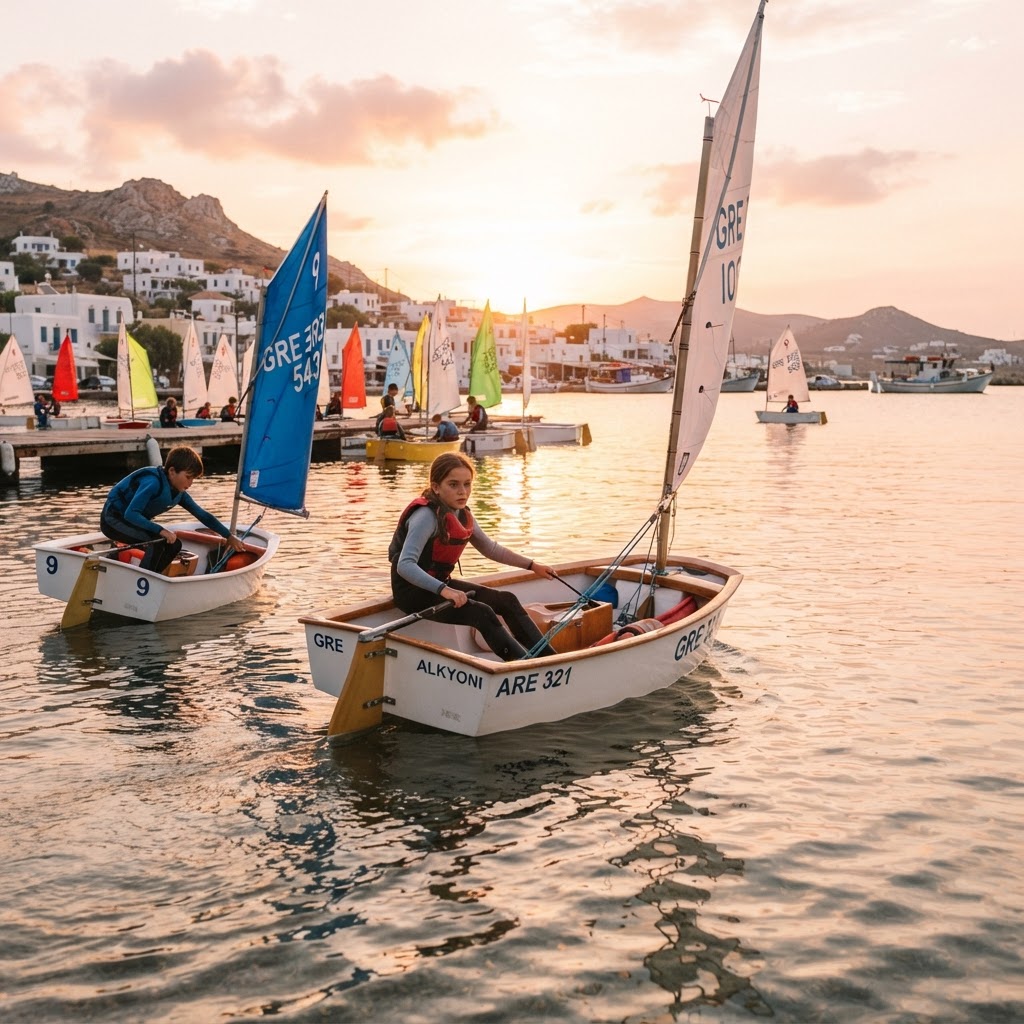
The Optimist is the most widespread training sailboat in the world: a small, single-handed dinghy designed exclusively for children. The vast majority of the world's top sailors — Olympic medalists, world champions, and even America's Cup crews — sailed their first miles in this humble boat. If your child is about to take up sailing, they will almost certainly start here.
A brief history
The Optimist was designed in 1947 in Florida, USA, by Clark Mills, with the goal of creating a boat so simple and affordable that any child could own one. From Scandinavia, where it became popular in the 1950s, it spread across the globe. Today, it is the largest international junior class, with hundreds of thousands of boats and organized races in over 100 countries — with Greece having one of the most vibrant communities in the Mediterranean.
Why it is the ideal first boat
The Optimist has a length of just 2.30 meters and a sail of approximately 3.5 square meters. Its characteristic 'square' bow is no accident: it provides exceptional stability, which is crucial for a child's confidence in their first steps. Air tanks keep it afloat even when full of water, while all controls — sail, tiller, daggerboard — are designed for children's hands.
Most importantly, however, is the pedagogical aspect: in an Optimist, the child is the sole skipper. There is no adult on the boat — the coach supervises from the accompanying RIB. This autonomy is what makes the Optimist a unique school of character: the child learns to make decisions, correct their mistakes, and trust their own judgment.
What ages it is for
Children usually start between the ages of 6-9 and, according to class regulations, compete in Optimists until the year they turn 15. The path within the class has stages: beginner group, pre-racing, and racing team, with participation in inter-club regattas, regional, and National Championships. After 15, athletes transition to larger boats such as the ILCA or the 420.
What a child learns in an Optimist
In the first lessons, the child becomes familiar with the boat and the sea: rigging, basic maneuvers, balance, controlled capsizes, and recoveries. Next come the points of sail, tacking and jibing, reading the wind, and later, the rules and techniques of racing. Each stage builds on the previous one, at a pace adapted to the child.
Beyond technique, the Optimist teaches responsibility: every athlete takes care of their own boat, rigs and de-rigs it themselves, washes it, and puts it away. These are small daily habits that parents quickly notice even off the water.
Optimist at NOAS
At the Nautical Athletic Club of Artemis Spata (NOAS), the Optimist department is the heart of the club. Training takes place in the shallow, protected waters of the South Euboean Gulf, with club boats provided for beginners, a safety boat accompanying every session, and coaches specialized in youth sailing. If you want your child to see what an Optimist is up close, the best start is to visit a training session and book a trial lesson.