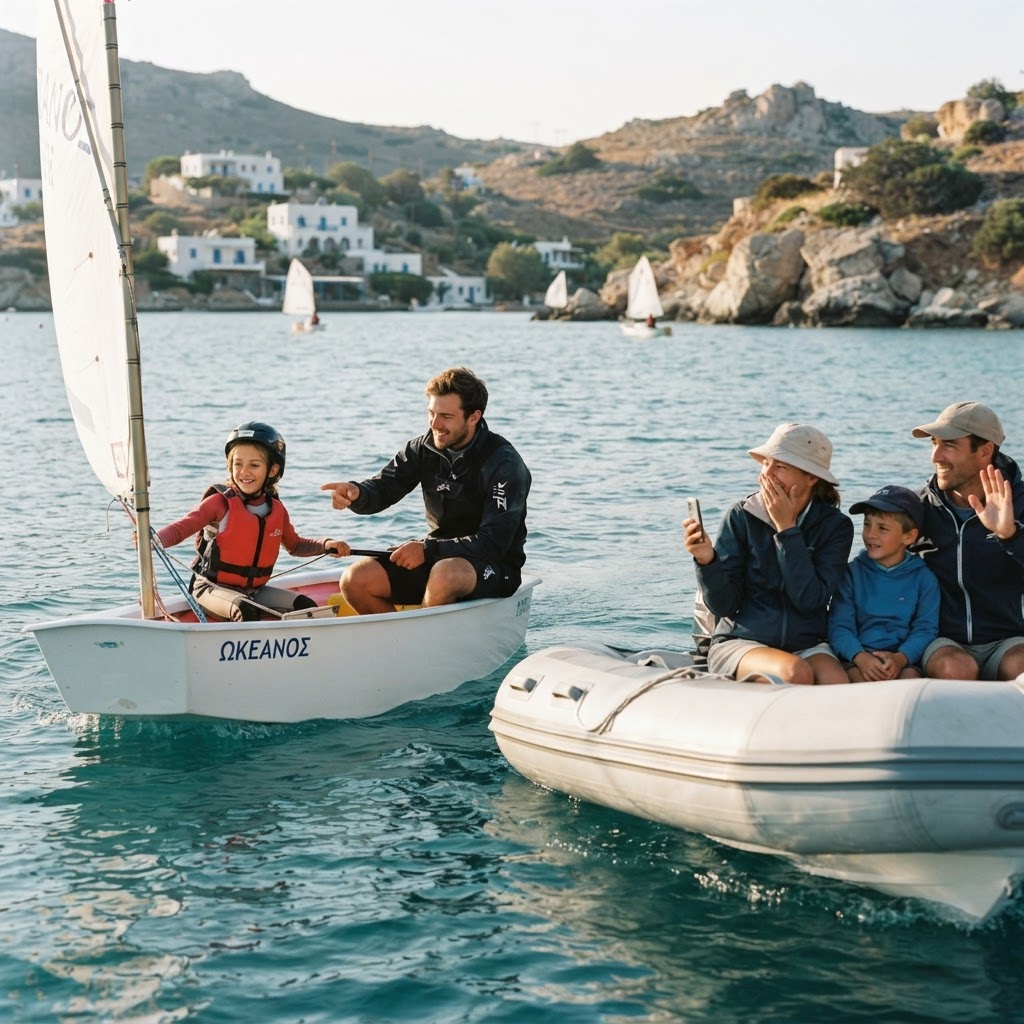
Sailing is the art and sport of moving a boat on the sea using the wind as its sole source of power. It is one of humanity's oldest forms of navigation and, at the same time, a modern Olympic sport that combines physics, strategy, athletic skill, and a deep connection with nature. In this guide, you will see how a sailboat works, what forms of sailing exist, the benefits it offers, and how you can get started — whether you are a parent looking for a sport for your child or an adult who dreams of the sea.
How does a boat move with the wind?
The sail of a sailboat is not simply 'pushed' by the wind, as many believe. In most points of sail, it functions like an airplane wing: air flowing over the two sides of the curved sail creates a pressure differential, and this difference generates the thrust that moves the boat forward. The keel or the centerboard under the water prevents the boat from drifting sideways, allowing the sailboat to travel even 'against' the wind — not exactly directly into it, but at an angle of about 40-45 degrees, through successive turns (tacks).
The basic directions of travel in relation to the wind are called points of sail: close-hauled (against the wind), reaching (with the wind from the side), and running (with the wind from behind). The sailor constantly adjusts the sail, their body weight, and the boat's heading to optimally utilize the wind at every moment.
Forms of Sailing
Sailing is divided into two major families:
Dinghy sailing: Small, open boats without a cabin, with a crew of one or two people, competing on set courses near the coast. This category includes the Optimist (the boat with which all children in the world learn), the ILCA (formerly Laser), the 420, and the 470. This is the form with which almost all sailors begin and the form cultivated in nautical clubs.
Offshore sailing: Larger boats with cabins and multi-person crews competing over longer distances. Legendary ocean races like the Vendée Globe belong here.
In the same family of sports are windsurfing, the Olympic iQFOiL board, and, as a related water sport, SUP.
Sailing as a Sport
Sailing has been an Olympic sport since the first modern Olympic Games. Races (regattas) are held on courses defined by buoys in the sea, and athletes compete in speed, tactics, and technique. A sailing race is like a game of chess played at 15-20 knots: the athlete reads the wind, anticipates its changes, chooses a side of the course, and 'battles' for position at the start and at the marks.
This makes sailing unique: it is both a physical and a mental sport. The young athlete in an Optimist exercises their body, but more importantly, learns to make decisions on their own, in real-time, within an environment that is constantly changing.
What do you gain from sailing?
Sailing cultivates skills that few sports offer in such depth: autonomy and responsibility (the athlete is the sole captain of their boat), decision-making under pressure, reading the natural environment, composure, persistence, and respect for the sea. Meanwhile, although each athlete competes alone, life in a club is deeply communal: children rig their boats together, travel together to races, and grow up in a community with a shared love for the sea.
For adults, sailing is a lifelong sport: you can learn it at any age and enjoy it for decades, whether competitively or for recreation.
Where and how to start?
The right starting point is a recognized nautical club, a member of the Hellenic Sailing Federation (HSF). There, you will find certified coaches, training boats, safety support boats, and a structured program that starts with theory on land and gradually moves into the water.
Children usually start at ages 6-9 in an Optimist. The first weeks include familiarization with the boat, basic handling, capsizing (in a controlled and safe way, so the child learns it is nothing to be afraid of), and lots of play in the water. Adult beginners follow similar programs on larger boats.
In East Attica, the Nautical Club of Artemis Spata (NOAS) offers Optimist, windsurfing, and SUP programs in the waters of the South Euboean Gulf — one of the most suitable sea training grounds in Attica, with steady thermal winds and a safe, shallow beach.
What does a beginner need?
You don't need almost anything of your own to get started: the boat, sails, and basic equipment are provided by the club. A beginner's personal equipment is limited to a life jacket (often provided by the club initially), swimsuit or lycra, sunscreen, hat, water shoes, and, for the colder months, a wetsuit. As the athlete progresses, the equipment is gradually enriched — but that is a decision that comes later, in consultation with the coach.
The first step
Sailing is not learned from articles — it is learned on the sea. The best first step is a visit to the club: to see a training session up close, talk to the coaches, and do a trial lesson. From there, the wind takes over.