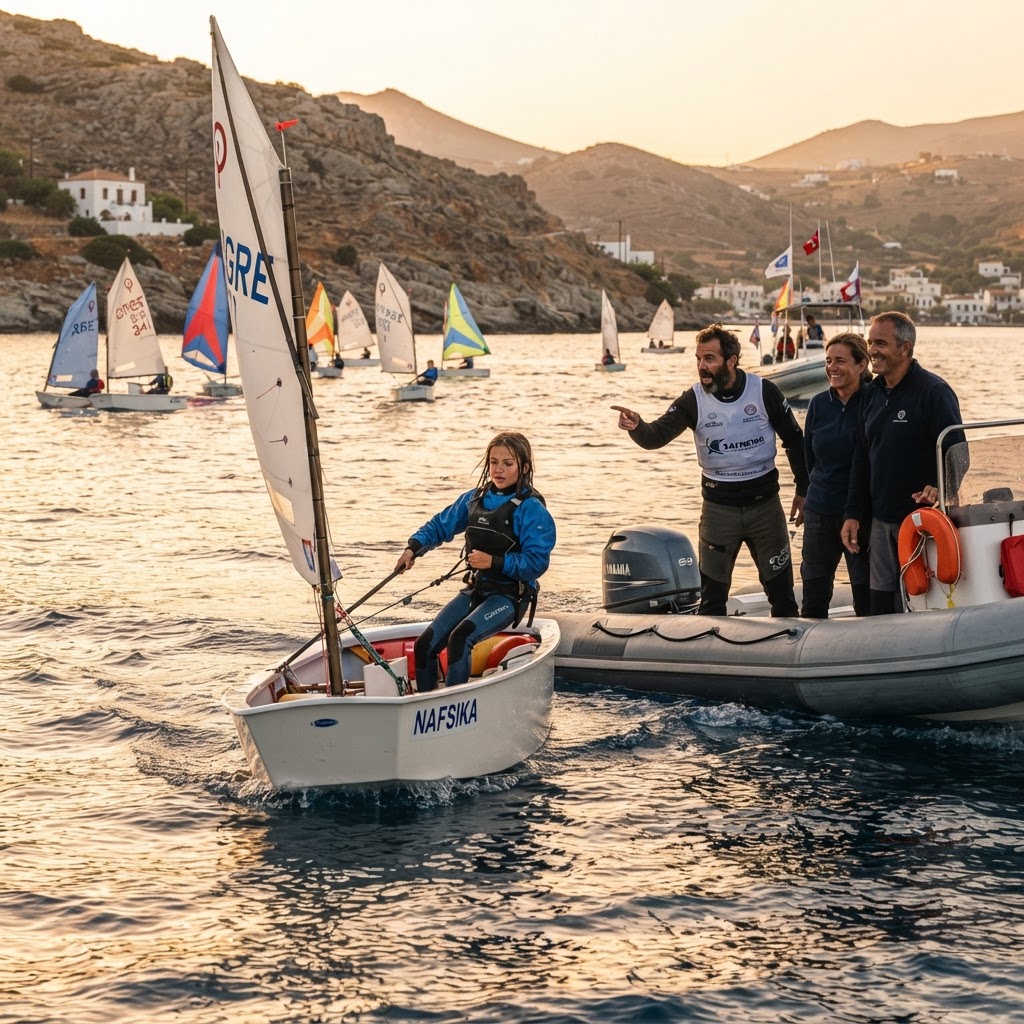
If you have ever watched a sailing race from the beach, it may have looked chaotic to you: dozens of boats circling buoys without any apparent logic. Yet, a sailing race (regatta) is a strictly structured game with rules, strategy, and a clear path. In this guide, you will understand how it works — whether you are a parent watching your child's first race or a young athlete.
The course: a 'stadium' of buoys
Before the race, the race committee sets up a course of inflatable buoys on the water. The most common route for Optimists is the trapezoid or triangle: the boats start upwind towards the first buoy (beat), go downwind (run), and finish at the finish line. An Optimist race usually lasts 30-50 minutes, and on a race day, 2-3 races are held.
The start: the most critical minute
In sailing, there is no 'starting block' as in track and field: the boats are constantly moving behind the imaginary starting line (between the committee boat and a buoy) and try to cross it with speed exactly at the moment of the signal. The process is conducted with sound signals and flags, in a 5-minute countdown. Whoever crosses the line early (premature start — OCS) must go back, otherwise, they are disqualified from that specific race.
The basic right-of-way rules
Regattas are governed by the Racing Rules of Sailing (RRS) of World Sailing. The three fundamental principles that every child learns early are:
Starboard tack has right-of-way. A boat receiving wind on its starboard side (right) has priority over a boat on a port tack.
The leeward boat has right-of-way. Between two boats on the same tack, the one further away from the wind (leeward) has the right.
Always avoid contact. Even if you have the right-of-way, you are obliged to avoid a collision.
Anyone who breaks a rule can 'self-penalize' by doing penalty turns on the spot; otherwise, the opponent can file a protest that is heard after the race. This is how children learn something rare: a sport without a referee on the field of play, which relies on the integrity of the athletes themselves.
Scoring
The system is simple: the 1st gets 1 point, the 2nd gets 2 points, etc. The winner of the event is the one who accumulates the fewest points across all races. In most events, after a certain number of races, the athlete 'discards' their worst result — so a bad start does not ruin the event.
What a parent sees from the beach
Parents watch from the shore — approaching the course is not allowed during the race. You will see the boats gathering behind the line, pouring out with the signal, 'climbing' in zig-zags towards the top buoy, and opening their sails on the downwind leg. The best advice for parents: ask your child what they learned, not where they finished.
From training to racing
At NOAS, the transition from the training department to the first races happens gradually and without pressure: first internal races during training, then inter-club races in Attica, and — for those who choose — regional and national championships. If you want to see what it's like up close, come to one of our club's events in Artemida — the sight of dozens of small sails on the Euboean Gulf is a spectacle in itself.