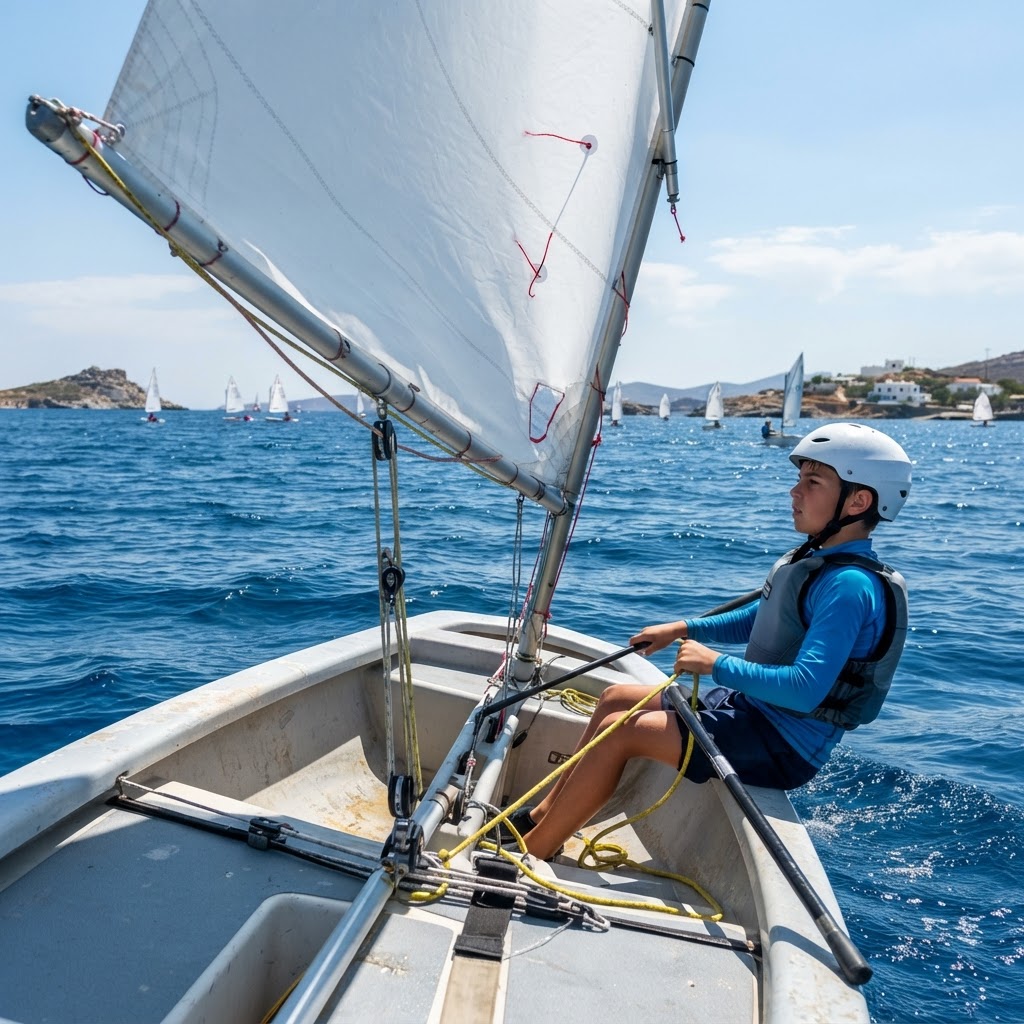
Introduction to Wind Shifts: The Art of Tactical Sailing
Sailing is a sport defined by the constant interplay between the sailor, the boat, and the environment. In the waters of the South Euboean Gulf, where the wind conditions can be as dynamic as they are challenging, mastering the art of 'reading the wind' is what separates a novice sailor from a competitive tactician. At the Nautical Athletic Club of Artemis Spata (NOAS), our Optimist academy focuses on teaching young sailors that sailing is not merely about steering in a straight line, but about understanding the invisible shifts that dictate the fastest path to the finish line.
Wind shifts are changes in the direction or pressure of the wind. For an Optimist sailor, recognizing these shifts early is essential. Whether you are racing or training, understanding how to leverage these changes can be the deciding factor in your placement.
Understanding Different Types of Wind Shifts
To effectively navigate the racecourse, a sailor must distinguish between two primary types of shifts: headers and lifts. A 'header' occurs when the wind shifts in a way that forces the boat to steer further away from its intended mark. When you are 'headed,' your sail starts to luff at the leading edge, and you must tack to regain the optimal angle toward the mark.
Conversely, a 'lift' is a sailor's best friend. This shift moves the wind toward the stern, allowing you to point higher toward the windward mark without changing your course. Learning to identify these moments is a core component of the sailing training provided here at NOAS. By focusing on the telltales on the mast and the pressure on the tiller, young athletes learn to anticipate these shifts before they fully manifest.
Tactical Strategies for the South Euboean Gulf
The geography of our home, the South Euboean Gulf, presents unique conditions. The local thermal winds often interact with the coastline, creating oscillating shifts that reward sailors who stay alert. Sailing strategy is not about following a rigid path, but about reacting to the rhythm of the wind.
When sailing upwind, always maintain a clear view of the fleet. If your competitors on one side of the course are gaining, it is likely they have found a lift or better pressure. In the Optimist, where the boat is highly sensitive to crew weight and trim, maintaining speed through a shift is crucial. If you attempt to point too high during a slight shift without enough speed, you will lose the momentum required to capitalize on the next gust.
The Importance of Sail Trim and Boat Handling
Strategy is useless without the technical ability to execute. As we teach in our academy, your sail trim must be dynamic. When a lift occurs, you can tighten your sheet to pull the boat higher into the wind. When a header hits, you may need to ease the sail slightly to maintain flow over the sailcloth, allowing the boat to remain powered up while you prepare to tack.
In the Optimist, the vang, sprit, and outhaul are your tools for adjusting the sail shape to match the wind's intensity. If you are experiencing frequent shifts, ensure your boat is tuned for the prevailing conditions. A boat that is difficult to handle will prevent you from responding quickly to tactical opportunities.
Mental Preparation and Situational Awareness
Racing psychology plays a massive role in how a sailor handles shifts. It is easy to become frustrated when a shift does not go your way. However, top-tier sailors view every shift as an opportunity to gain an advantage. At NOAS, we encourage our athletes to keep their heads out of the boat. Looking at the water surface, observing the ripple patterns, and watching other boats are all parts of 'reading' the course.
Remember that the wind is rarely uniform. It moves across the water in patches. By positioning yourself in a way that maximizes your time in these favorable patches, you are effectively executing a high-level sailing strategy. This mindset starts early in our academy, where we transform the fear of the unknown into the excitement of discovery.
Join the NOAS Community
Whether you are a beginner looking to understand the basics or a racing enthusiast eager to refine your tactics, the South Euboean Gulf offers the perfect classroom. Sailing is more than a sport; it is a life skill that fosters resilience, focus, and a deep connection with nature. We invite you to visit our facilities in Artemis to meet our coaches, see our training methods firsthand, and perhaps schedule a trial lesson. Come and feel the wind for yourself and become part of our vibrant sailing family.