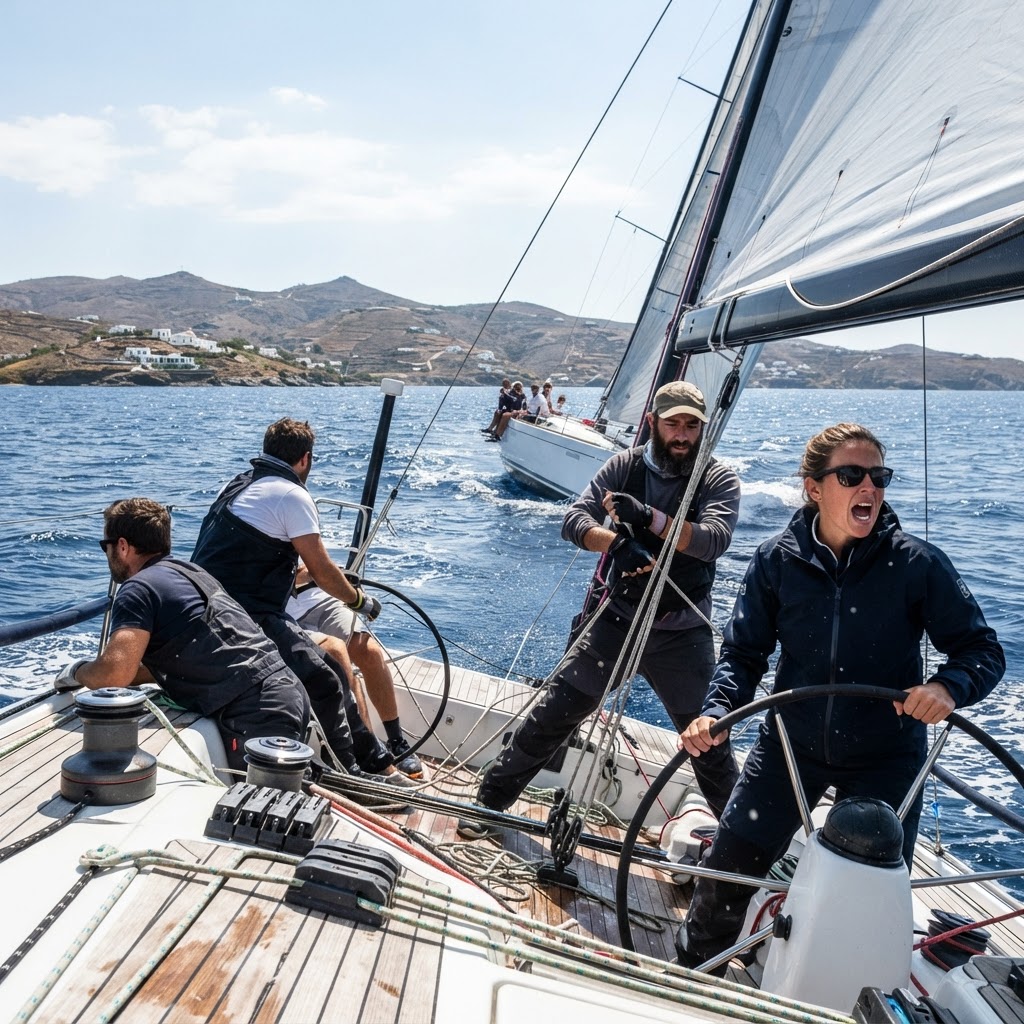
Introduction to Race Strategy and Tactics
Sailing is not just a test of speed, but a dynamic game of chess on the water. At the Nautical Athletic Club of Artemida-Spata (NOAS), we teach our athletes that victory is determined not only by how fast you can trim your sails, but by how intelligently you make decisions in the heat of the race. The Southern Evian Gulf, with its unique conditions, is the ideal field to perfect your tactical knowledge.
The Importance of Strategy Before the Start
Before the starting signal even sounds, a competent sailor has already analyzed the course. Strategy concerns the plan you make to position yourself on the most favorable side of the track. Consider the wind direction and the changes expected. In the waters of Artemida, we often observe small variations in intensity or direction due to the morphology of the coastline. Knowledge of the local weather is the first step toward a successful tactical approach.
Basic Tactical Principles During the Race
Tactics during the race are divided into immediate reactions and planned moves. The most basic principle is the protection of your boat and "clean air." We always aim to sail in clean wind, avoiding the wake of the boats ahead. If you find yourself in a position where your wind is "dirty," your tactic dictates an immediate change of course or a tack to regain your speed.
Opponent Management and Fleet Control
At a competitive level, managing opponents is crucial. If you are in front, your tactic is to "mark" the closest opponent, hindering their attempts to overtake you. Conversely, if you are behind, the tactic shifts to finding a clear lane that will allow you to take advantage of wind shifts and close the gap. In our NOAS Optimist sections, our athletes learn to recognize these moments from a young age.
Using Shifts and Upwind Sailing
Understanding when to tack when the wind changes is perhaps the most important skill. When the wind turns "towards you" (header), it is the moment for a tack so that you return to the correct course toward the buoy. Patience and observation are the sailor's best allies. Practice in our waters will give you the necessary "eye" to see the next shift before it happens.
Tactics at the Buoys and the Importance of Position
Mark rounding is the moment where much is decided. The basic principle is maintaining speed and avoiding collisions that lead to penalties. The inside overlap provides the advantage, which is why the tactical approach must start early, placing your boat in a position of power before the three-length zone.
Conclusion and Next Steps
Tactics is a skill cultivated through constant engagement with the sea. At NOAS, our Academy offers an environment where theory becomes practice under the guidance of experienced coaches. We look forward to seeing you at our club to discuss technical details, analyze the racecourse, and improve your performance together. For any information regarding our sections or registration possibilities, please contact our secretariat.
Sailing is a journey. It is the art of using nature as an ally. Come sail with us in the waters of Artemida and build the foundation for your future successes.