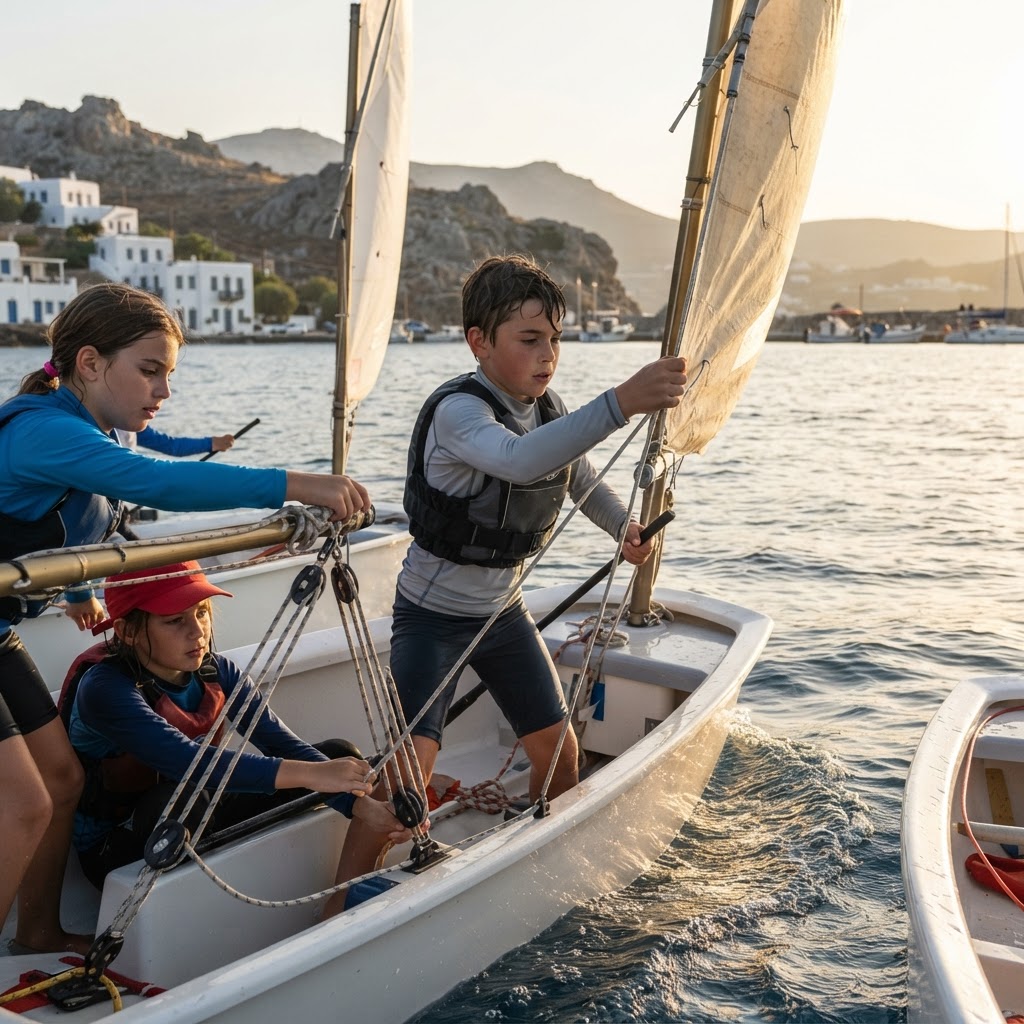
Introduction to Optimist Trim: The Art of Speed
At the Nautical Athletic Club of Artemida and Spata (NOAS), the waters of the South Euboean Gulf are the ideal field for a young athlete to discover the magic of sailing. The Optimist is not just an introductory boat; it is a technological tool that requires precision, an understanding of physical forces, and constant experimentation. Proper sail trim is not a privilege reserved for advanced sailors, but the foundation for the sailor to gain control of their boat.
The Sprit: The Shape Regulator
The sprit (the pole that supports the top of the sail) is perhaps the most misunderstood component on an Optimist. Its function is to give shape to the sail by stretching the head toward the clew. When the wind is light, we want the sail to have a 'fuller' shape, so we slacken the sprit slightly. Conversely, in strong winds—often encountered off the coast of Artemida—we must tension the sprit more to flatten the sail and shed unnecessary pressure.
Outhaul: Power in the Lower Section
The outhaul regulates the tension at the foot of the sail. A basic rule we teach our students is: less wind means less outhaul, resulting in a deeper sail that provides more power. When the wind increases, we pull the outhaul to 'deflate' the lower part of the sail. This helps prevent the boat from heeling excessively and maintains speed while sailing upwind.
Vang: Controlling the Boom
The vang is the mechanism that controls the boom and, consequently, the twist of the sail. In an Optimist, the vang is critical, especially when sailing downwind or reaching. In light winds, we leave the vang looser so the sail can 'breathe.' In heavy air, we tighten it to prevent the boom from lifting and to maintain the stability of the boat.
The Importance of Adjusting to the Conditions of the South Euboean Gulf
The South Euboean Gulf has its own peculiarities. We often face changing conditions, from gentle breezes to more demanding swells. A NOAS athlete must learn to read their sail. If the sail has many wrinkles near the mast, it may need more tension on the lines. If the sail looks flat as a board while the wind is light, the settings need immediate loosening.
The NOAS Academy: Join us to learn in practice
Theory is the beginning, but the sea is the teacher. At NOAS, the Sailing Academy focuses on the practical application of these settings. Through games and training, our young sailors learn how every centimeter of tension on the outhaul or sprit translates into better speed and easier steering. Whether you are a beginner or want to improve your racing performance, our coaching team is here to guide you. Contact our office today to book an orientation or to participate in a trial lesson.