Understanding Ocean and Tidal Currents in Competitive Sailing
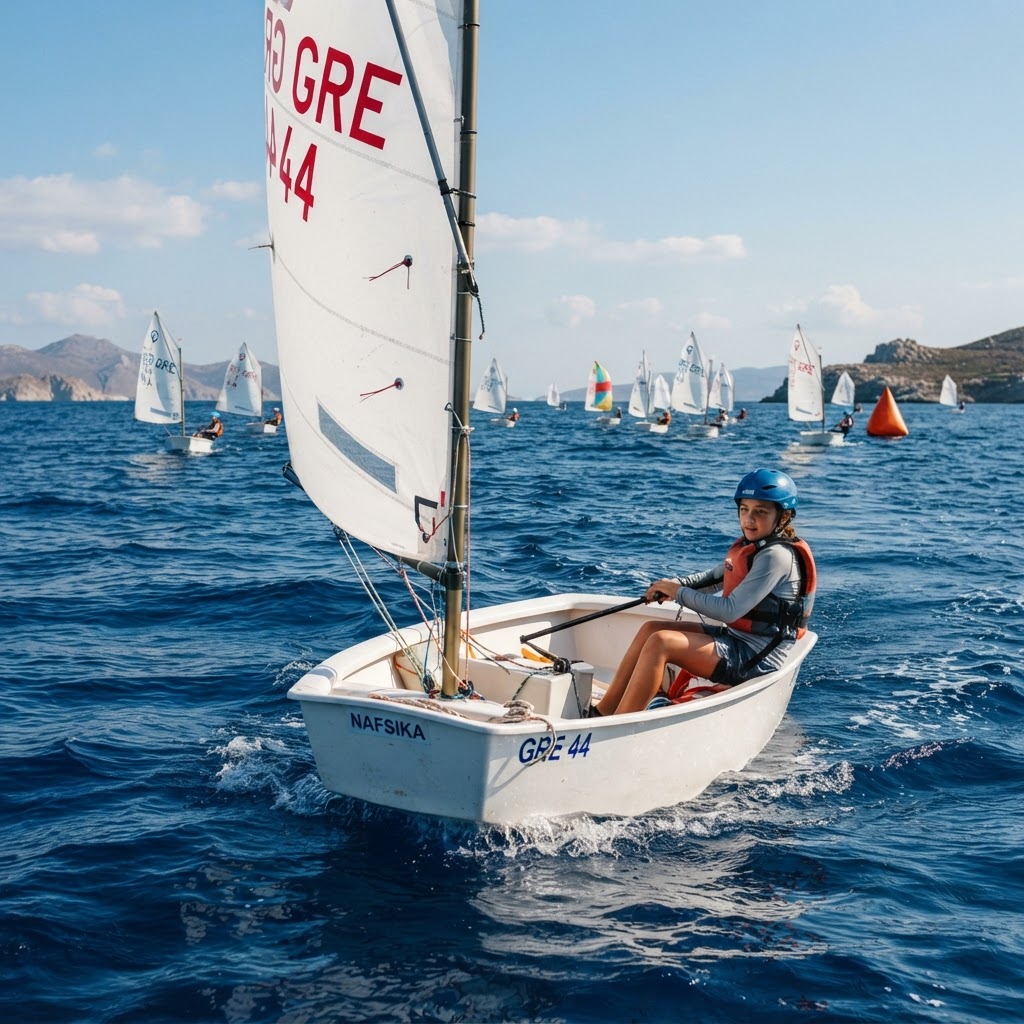
For young sailors starting their journey at the Artemida Nautical Sports Club (NOAS), the sea is more than just a playground; it is a complex, dynamic environment. While wind is the primary force moving an Optimist dinghy, understanding water movement—specifically currents—is what separates the good sailors from the great ones. In the waters of the South Euboean Gulf, while tides may be subtle compared to the open ocean, the local current patterns often dictate the winning strategy in a regatta.
What are Ocean and Tidal Currents?
In simple terms, a current is the horizontal movement of water. In the context of competitive sailing, we are usually dealing with tidal currents, driven by the gravitational pull of the moon and sun, or wind-driven currents, caused by sustained winds pushing the surface layer of the water. Even a slight drift can push an Optimist away from its intended layline, making knowledge of the local water flow essential for success.
How Currents Affect Your Boat Speed
When you are sailing in a current, your boat speed is relative to the water, not the bottom. If you are sailing at 3 knots and there is a 0.5-knot current pushing you from behind (a following current), your speed over ground becomes 3.5 knots. Conversely, sailing against it drops your speed to 2.5 knots. In a competitive fleet, this half-knot difference is massive over the course of a race. Learning to identify these invisible forces is a core part of the training here at NOAS.
Strategic Positioning in the Euboean Gulf
At NOAS, our coaches emphasize that strategy begins before the starting gun fires. In the South Euboean Gulf, coastal geography plays a huge role in current behavior. Currents tend to accelerate around headlands and slow down in sheltered bays. Understanding these variations allows you to choose a path that maximizes your speed over ground. We encourage our young athletes to observe the "signs" on the water: eddies near rocks, ripples in calm areas, or the way markers are leaning against the flow.
The Impact on Race Tactics
When a current is present, your tactical decisions—such as when to tack or which side of the course to favor—must be adjusted. If the current is flowing from right to left, the right side of the course might be more favorable even if the wind seems slightly better on the left. This requires a shift in thinking: you aren't just sailing against the wind; you are navigating a moving platform. Mastering these nuances is a key component of the advanced training modules within our Optimist racing team.
Training at NOAS: From Theory to Practice
At the Artemida Nautical Sports Club, we believe that academic knowledge must be applied on the water. During our training sessions, we introduce drills that force sailors to calculate their drift. By placing marks in areas with known currents, our students learn how to adjust their steering and trim to stay on course. This hands-on experience is what gives our athletes the confidence to perform under pressure during high-level regional regattas.
Tips for Young Sailors
- Observe the Marks: If the current is pushing against the mark, it will appear to be moving towards you or away from you. Watch how other boats are affected as they round it.
- Trust Your Compass: In light winds, the current can be deceptive. A compass helps you maintain a heading relative to the land, regardless of the drift.
- Stay Alert: Currents are not static; they change with the tide and wind. Constant monitoring is the secret to staying ahead of the fleet.
Join Our Sailing Family
Understanding the hidden forces of the sea is a lifelong journey, and there is no better place to start than the vibrant, supportive community of the Artemida Nautical Sports Club. Whether your child is a complete beginner or looking to sharpen their competitive edge, our academy provides the resources and expertise to help them excel. We invite you to visit our facilities at the seaside, meet our coaching staff, and learn more about our upcoming training programs. Come join us and discover the thrill of sailing in the beautiful waters of the South Euboean Gulf!