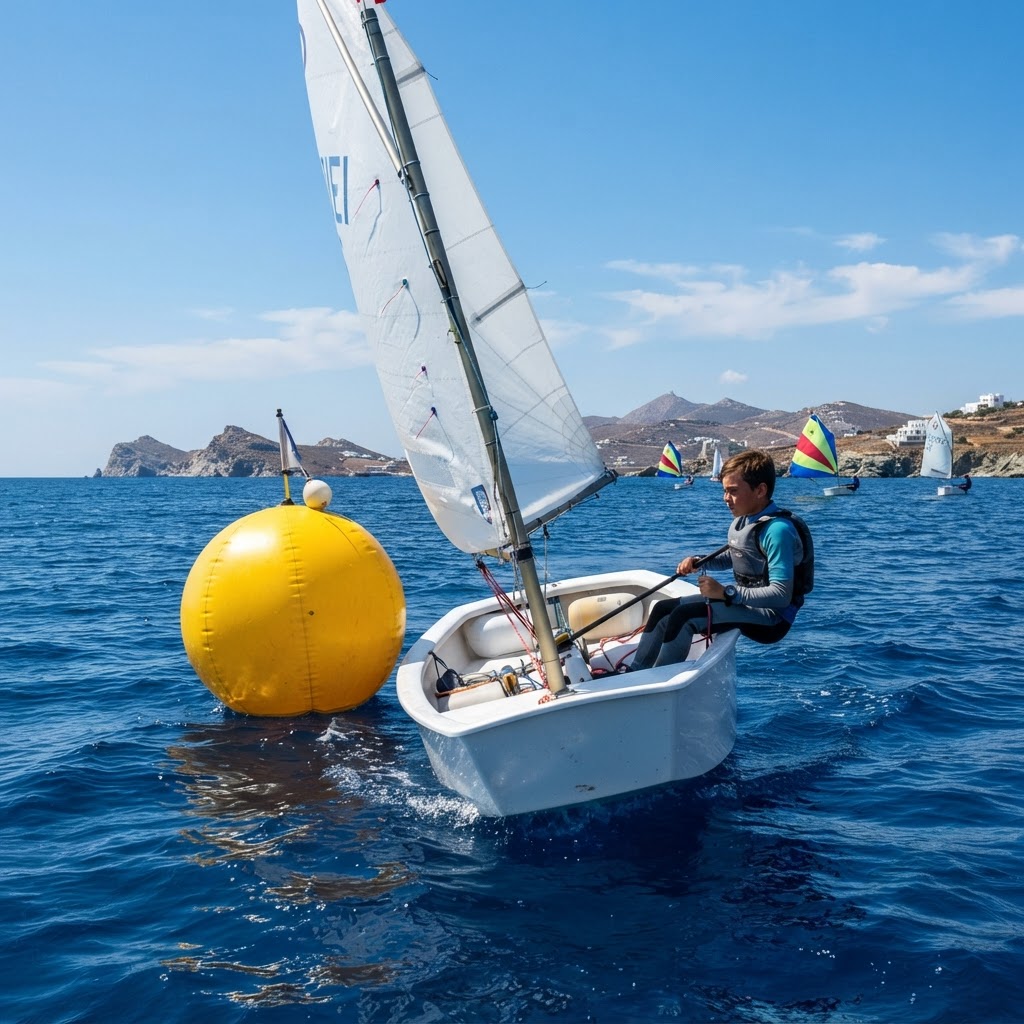
Mastering the Art of Mark Rounding in Optimist and ILCA Racing
In the world of dinghy racing, a race is rarely won on a long, straight leg. Instead, it is frequently decided in the chaotic, high-pressure seconds when rounding a mark. For our young sailors at the Nautical Athletic Club of Artemis-Spata (NOAS), mastering mark rounding is the transition point from being a passenger in a boat to becoming a tactical racing sailor. Whether you are sailing an Optimist in our sheltered South Euboean Gulf waters or moving up to the ILCA fleet, the ability to maintain speed while changing direction is the hallmark of a skilled competitor.
The Physics of the Mark Rounding
At its core, a mark rounding is a compromise. You are sacrificing a small amount of speed to alter your heading, while trying to manage the interaction between the wind, your sail trim, and the water flow across your rudder. In an Optimist, where the hull is flat-bottomed and lacks the complex foil dynamics of larger yachts, the sailor’s body weight acts as the primary tool for leveling the boat and controlling the turn.
When approaching a mark, your goal is to minimize distance covered while maximizing your exit speed. We often see beginners at NOAS turning their rudders too aggressively, causing the boat to act as a brake rather than a vehicle. Remember: the rudder is a source of drag. A sharp, jerky turn kills your momentum instantly.
Approaching the Windward Mark
The windward mark is the ultimate test of racing strategy. As you approach on a port or starboard tack, you need to decide your lane early. In the South Euboean Gulf, the local thermal breezes can be fickle. If you are on a starboard tack and have rights, use that final moment to squeeze up to the mark, but ensure you are not pinching—losing your tell-tales' flow—just to make the turn.
Once you arrive, the transition from 'upwind' to 'downwind' mode must be fluid. As you round, your body should be leaning outward to keep the boat flat. An Optimist that is heeling excessively during a rounding will drift sideways, wasting precious meters. Use the 'roll' technique: roll the boat slightly to leeward to initiate the turn, and then level it off as you bear away to ensure the sail catches the wind instantly for the reach.
The Leeward Mark: Where Positions Are Won
Leeward mark roundings are often more congested. With the wind behind you, the pressure is higher, and the risk of rule infractions is greater. Your approach should be a 'wide-in, tight-out' strategy. By coming in slightly wide, you gain a better angle to turn your boat into a close-hauled position, ensuring you aren't forced to sail a 'hook' after the mark.
Keep your eyes on the fleet around you. In the choppy conditions we sometimes encounter in our training ground at Artemis, keeping the boat moving is more important than getting the tightest possible turn. If you lose your flow, you lose the race. Shift your weight forward as you round to release the stern, allowing the boat to pivot more efficiently.
Body Positioning and Sail Trim
Your body is a part of the boat's sail plan. During a rounding, you must be in constant motion. For our Optimist sailors, the transition from hiking out to sitting inside or across the boat needs to be seamless. If you are rounding the leeward mark, you should be moving from the windward side to the leeward side to facilitate the turn, then back to the new windward rail as you trim in for the next leg.
Do not forget your controls. The vang and the outhaul should be adjusted based on the next leg of the course. A common mistake we notice in our academy is sailors who round the mark and then spend ten seconds fiddling with their ropes. Set your controls before the rounding whenever possible, so your hands are free to steer and balance the boat.
Racing Tactics and the RRS
Mark roundings are high-risk zones for Rule 18 (Mark-Room) incidents. Understanding the Racing Rules of Sailing (RRS) is not just about avoiding penalties; it is about confidence. When you know you have the right to room, you can approach the mark with the aggression needed to hold your position. At NOAS, we emphasize that a calm head during a rounding—knowing exactly where you stand in the sequence of boats—is worth more than raw speed.
Joining the NOAS Community
Understanding these techniques takes time and consistent practice on the water. The South Euboean Gulf provides the perfect laboratory for these maneuvers, offering varied wind conditions that challenge our sailors every day. Whether you are looking to refine your Optimist technique or considering your first steps in the ILCA class, the coaches at NOAS are here to guide you.
We invite all young sailors and their parents to visit our premises at the beach of Artemis. Come see our training sessions, meet our instructors, and learn more about our structured racing programs. Sailing is a journey, and every mark rounded is a step toward becoming a more capable, confident athlete. Contact our secretariat today to schedule a trial session or to ask any questions about our upcoming academy schedule. We look forward to seeing you on the water.