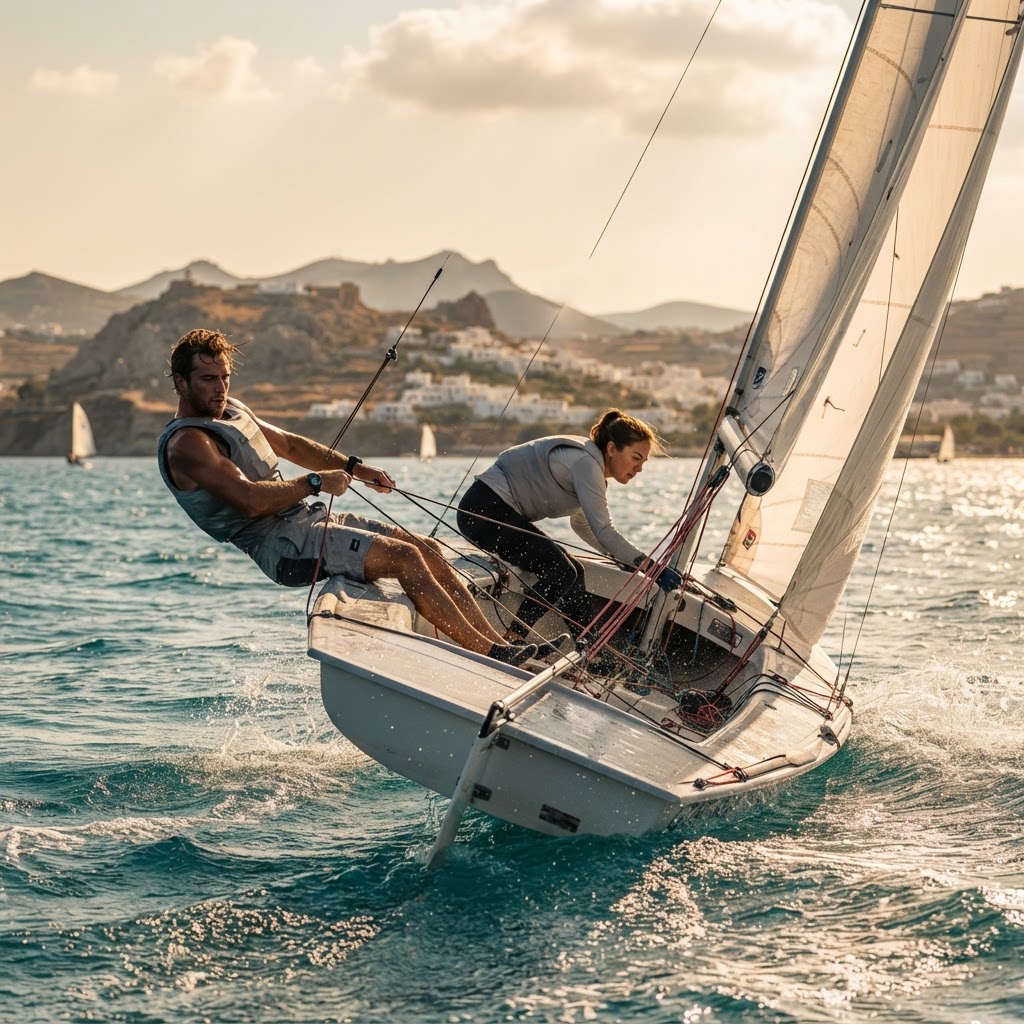
Introduction to the Roll Tack: Why does it matter?
In the magical world of sailing, especially when talking about boats like the Optimist, speed depends not only on how strong the wind is or how well we read it. It depends on how efficiently we execute our maneuvers. The roll tack is the technique that allows a sailor to change course while maintaining or even increasing the boat's speed during the tack. For NOAS athletes, who train in the unique waters of the South Euboean Gulf, mastering this technique is the key to standing out in competitive conditions.
The Basic Philosophy of the Roll Tack
The central idea of the roll tack is to use our body weight to "roll" the boat exactly as we pass through the wind. This movement reduces the boat's surface area in contact with the water and allows the sail to maintain its shape and aerodynamic pressure. When the boat heels, the centerboard acts as a lever that helps the boat "turn" faster, taking advantage of inertia.
Step 1: Preparation and Approach
Before you even start the tack, preparation is everything. You must have speed. Never attempt to perform a roll tack without having "loaded" the boat with sufficient momentum. As you approach the turning point, check the wind gusts in the South Euboean Gulf. If the wind is unstable, you may need to adjust the intensity of your roll. Keep the boat level until the moment of execution.
Step 2: The Roll
Once you turn the tiller, begin to transfer your weight to the side of the boat opposite to the wind. In an Optimist, this means you must move to the side that will become the new windward side. The boat must heel significantly. The angle of heel is critical: too little and you gain nothing; too much and the boat may "brake" due to the drag of the centerboard.
Step 3: Sail Crossing and Timing
As the boat reaches its maximum heel, the sail will cross to the other side. This is the moment when you must pull the sail in quickly (but not violently) to help the boat "rise" to its upright position. Timing is the secret here: the sail must be ready to catch the wind exactly when the boat aligns with the water.
Step 4: Exit and Recovery of Speed
After the boat passes through the wind and the sail fills, bring your weight back to the center. Do not "drop" suddenly into the boat. The movement must be fluid. Check your course again and ensure the boat has not lost speed. If you feel the boat is "stalling," you may need to "pump" it a little more with the sail before returning to your course.
Tips for NOAS Athletes
In the waters of Artemida, we often encounter specific wave and wind conditions. Do not be discouraged if your first roll tacks are not perfect. Sailing requires repetition. Observe our more experienced athletes and try to copy the flow of their body movement. Practicing in light or no-wind conditions is the best way to master the proper technique.
Come Learn With Us
Sailing is a sport that cultivates the body and the mind. At the NOAS academy, we teach not only techniques but also respect for the sea and love for the sport. If you want to improve your skills, we invite you to visit our facilities in Artemida. Contact our club's secretariat for information regarding trial lessons and become part of our sailing family.