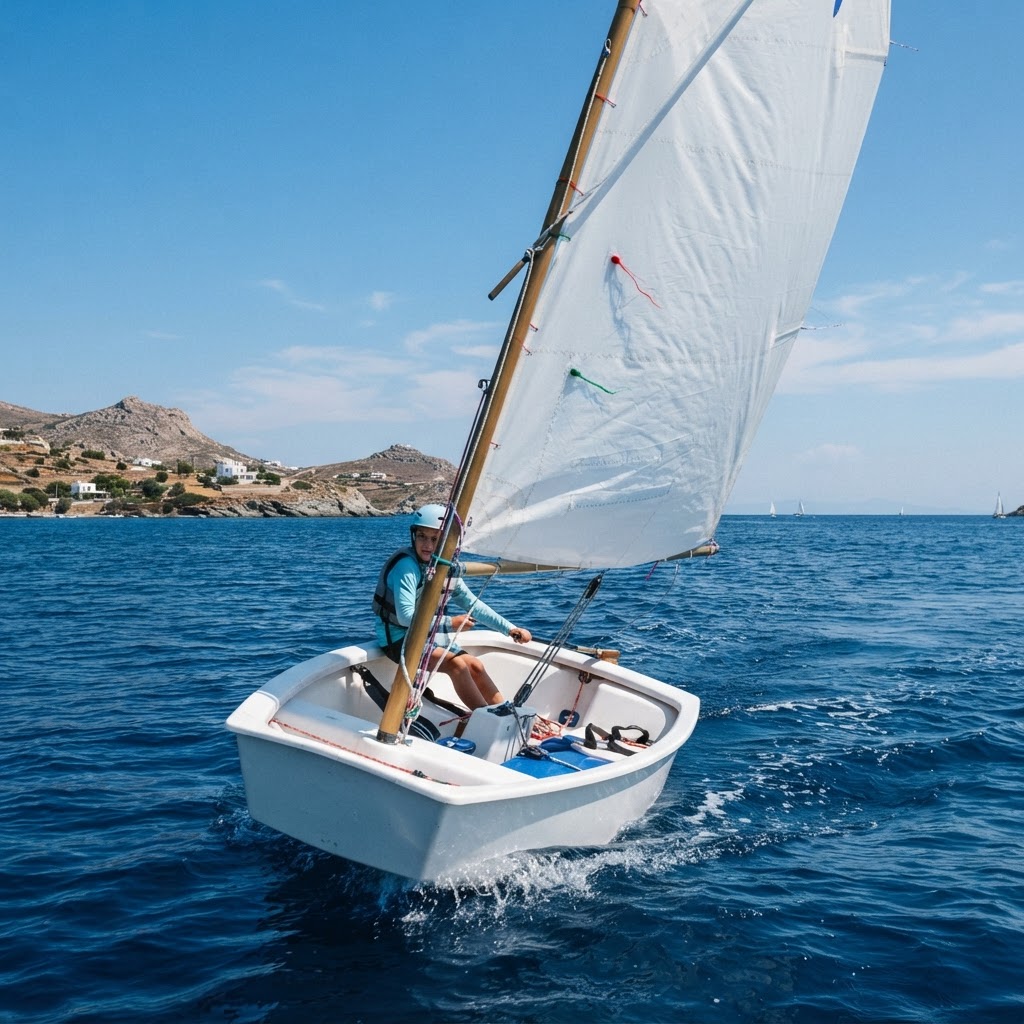
Introduction to Sail Aerodynamics: The Physics of Sailing
Sailing is often viewed as a romantic, almost artistic endeavor—a dance between the boat and the wind. However, at the core of every successful maneuver on the water, especially for our young sailors at the NOAS Optimist Academy, lies a profound physical phenomenon: sail aerodynamics. Understanding how a simple piece of fabric can propel a boat against the very wind that pushes it is the first step toward mastering the art of sailing. Whether you are navigating the refreshing breezes of the South Euboean Gulf or preparing for a local regatta, grasping the fundamentals of lift and drag is essential.
The Anatomy of the Sail: A Wing in the Wind
To understand how an Optimist moves, we must stop thinking of the sail as a flat screen and start seeing it as an airfoil—the same shape as an airplane wing. When air encounters the leading edge of a sail, it splits. One path follows the curved outer side (the leeward side), while the other travels along the flatter inner side (the windward side).
According to the Bernoulli principle, as the air on the curved leeward side accelerates to meet the air on the other side, the pressure drops. This creates a pressure differential: higher pressure on the windward side and lower pressure on the leeward side. This difference generates a force perpendicular to the sail, known as lift. In the case of our young sailors in Artemis, this lift is what pulls the boat forward.
The Delicate Balance: Lift vs. Drag
While lift is our best friend, drag is the persistent antagonist. Sail aerodynamics is essentially the management of the trade-off between these two. Drag is the resistance the sail faces as it pushes through the air.
At the NOAS training sessions, our coaches emphasize that improper sail trim can significantly increase drag. If a sail is "stalled"—meaning the air flow is no longer smooth and attached to the sail fabric—the lift decreases and the drag spikes, causing the Optimist to lose momentum. Achieving the perfect sail shape is about keeping the airflow attached for as long as possible, minimizing turbulence, and maximizing that precious forward thrust.
Applying Aerodynamics in the Optimist
For the Optimist sailor, the theory of aerodynamics is not just abstract physics; it is a practical tool used every time they step onto the water here in Artemis. The Optimist has a unique sail design that allows for specific adjustments. By using the sprit, outhaul, and vang, the sailor alters the depth and tension of the sail.
- Depth (Camber): A deeper sail generates more power in lighter winds on the South Euboean Gulf, but also creates more drag.
- Tension: A tighter outhaul flattens the sail, which is ideal for stronger winds where you need to reduce drag to maintain stability.
Learning to read the "tell-tales"—those small ribbons attached to the sail—is the most direct way to visualize aerodynamics in action. If they are flowing horizontally, the airflow is attached and efficient. If they dance erratically, the sailor knows it is time to adjust their trim.
Sailing in the South Euboean Gulf: Local Conditions
At NOAS, we are blessed with a unique environment. The local wind patterns of the South Euboean Gulf provide a perfect laboratory for our athletes. The thermal breezes that often grace our coastline allow for a variety of conditions, forcing our sailors to constantly adapt their aerodynamic profile.
Understanding how to trim the boat when the wind shifts from the sea to the shore is what separates a recreational sailor from a competitive racer. Our academy focuses on these practical applications, ensuring that every child understands not just how to pull a rope, but why that adjustment changes the shape of their sail and, consequently, their speed.
Conclusion: Start Your Journey at NOAS
Mastering sail aerodynamics is a lifelong journey. It begins with the first time a child feels the Optimist heel over and surge forward in response to a subtle shift in the sheet. At the NOAS academy, we provide the foundational knowledge that turns curiosity into technical skill. If you are interested in seeing these principles in action or wish for your child to join our vibrant community in Artemis, we invite you to contact our secretariat to schedule a trial lesson. Let us teach them how to harness the wind.