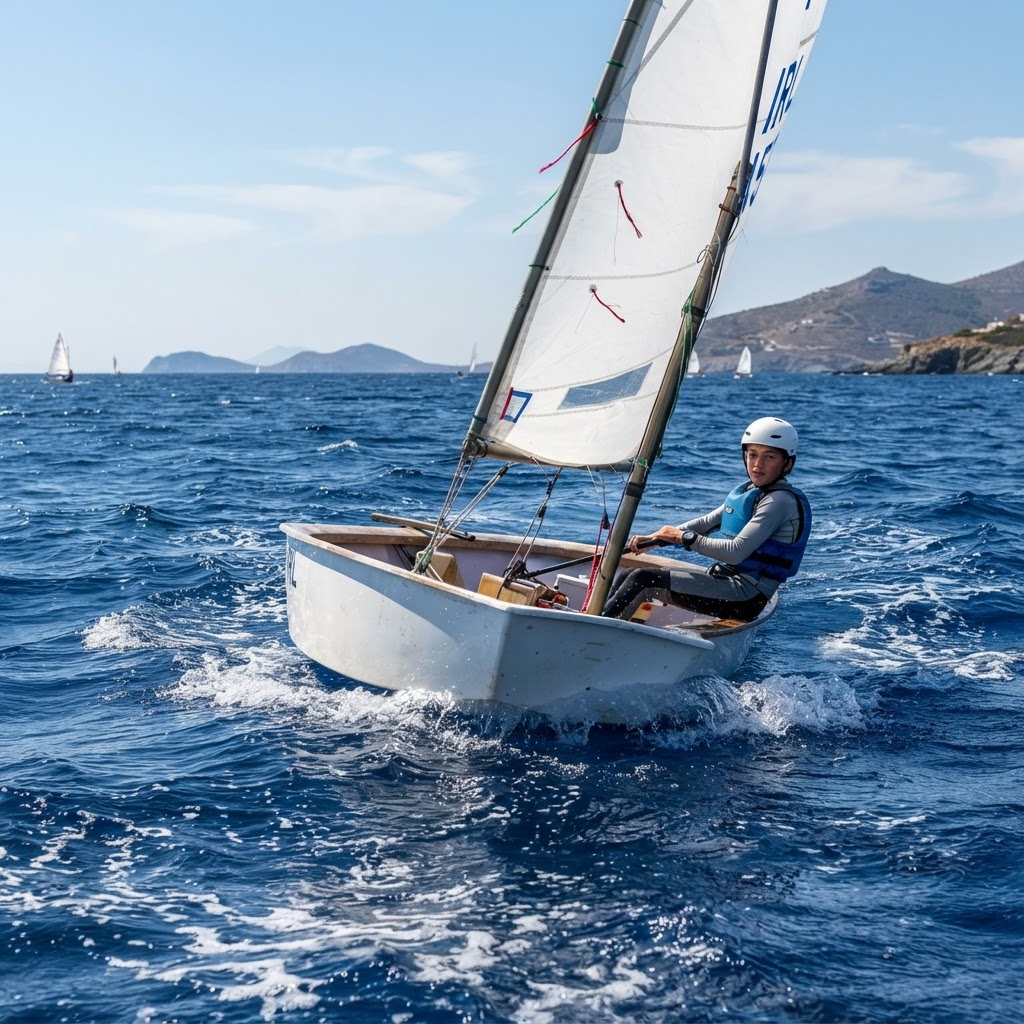
Understanding Wave Dynamics in Sailing
Sailing is a sport defined by the constant interaction between the vessel and the fluid environment. In the waters of the South Euboean Gulf, off the coast of Artemida, sailors learn very quickly that the sea is never static. For our young athletes at the Nautical Club of Artemida and Spata (NOAS), mastering wave dynamics is a fundamental step in transitioning from beginners to confident racers. Whether you are sailing an Optimist, an ILCA, or navigating on a windsurfing board, the waves are not just an obstacle—they are an energy source that, when managed correctly, can propel you forward.
The Physics of Waves and the Optimist
The Optimist dinghy, the cornerstone of our academy, is a flat-bottomed boat designed to be stable, yet it is highly sensitive to water movement. When a wave approaches the bow, it creates a resistance that can slow the boat down. The key to maintaining speed is to minimize the energy lost during these impacts. By shifting the body weight and adjusting the sail trim, a young sailor can encourage the Optimist to 'glide' over the water surface rather than 'plowing' through the chop.
Reading the Euboean Gulf
At NOAS, we are fortunate to operate in the South Euboean Gulf, a venue known for its varied wind and wave conditions. These waters provide an excellent classroom for understanding wave frequency and amplitude. Beginners are taught to observe the rhythm of the waves. Before even launching, our coaches encourage sailors to stand on the beach at Artemida and watch how the waves interact with the shoreline. This observation period is vital because it teaches the sailor to anticipate the 'lift' and 'drop' of the boat. Understanding the period between waves—the distance from one crest to the next—is what allows a sailor to make split-second decisions on when to tighten the sheet or when to lean out.
Sailing Techniques for Rougher Conditions
As our athletes progress, they learn specific techniques to maintain momentum in choppy water. When sailing upwind, the primary challenge is keeping the sail full and powered without the boat getting pushed sideways. We teach our students to keep the boat as flat as possible. If the boat heels too much, the rudder becomes less effective, and the drag increases significantly.
Another crucial technique is 'surfing' the waves downwind. By catching the front face of a wave, a sailor can achieve speeds that feel like flying. This is where the true joy of sailing is found. It requires coordination, timing, and a deep connection with the boat’s balance. In our ILCA and Optimist classes, we emphasize that the boat should always remain 'under the sailor,' meaning the athlete is in control of the vessel’s trim at all times, regardless of how chaotic the sea state might appear.
The Role of Body Weight and Balance
In the context of the South Euboean Gulf, where winds can shift rapidly, body weight is your most important tool. For an Optimist sailor, moving forward or aft to change the boat’s trim is an essential skill. When hitting a wave, moving the weight slightly back keeps the bow from burying itself. As the boat descends from the crest, shifting weight forward helps it accelerate. This rhythmic movement of the body is what we call 'pumping' or 'dynamic sailing' in a broader sense. It bridges the gap between passive floating and active racing.
Safety and Respect for the Sea
While mastering wave dynamics makes for faster sailing, safety remains the priority at NOAS. Every student is taught that the sea must be respected. Understanding wave energy also means understanding the limits of the equipment. Our coaches are always present during training sessions to ensure that as children learn to push their limits, they do so within a safe framework. We foster an environment where children feel secure enough to experiment with their technique, knowing that the NOAS safety boats are never far away.
Joining the NOAS Academy
Are you looking to help your child develop new skills, build self-confidence, and spend time in the beautiful waters of Artemida? The NOAS sailing academy is the perfect place to start. From the humble beginnings in an Optimist to more advanced racing in ILCA or the thrill of windsurfing and SUP, our programs cater to all levels of interest and experience. Our instructors are dedicated to teaching not just the mechanics of sailing, but the nuances of the environment that make this sport so rewarding.
If you want to witness these wave dynamics in action or learn more about our training programs, we invite you to visit our facilities. You can contact our secretariat to schedule a trial session or to get detailed information about our registration process. Come and discover why the South Euboean Gulf is the ideal playground for the next generation of sailors.