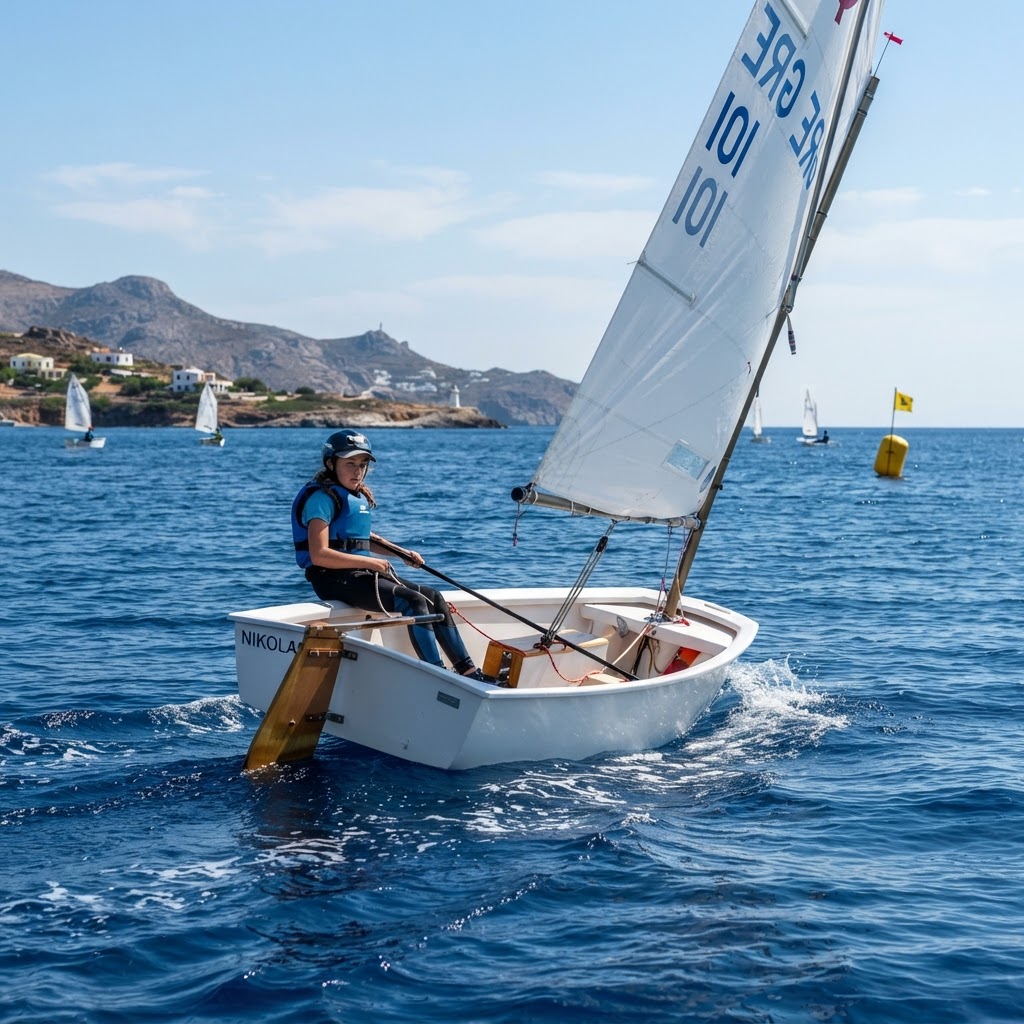
Understanding Laylines: The Strategic Path to the Mark
In the world of competitive sailing, success is often determined not just by the speed of your boat, but by the efficiency of your path. For young sailors at the Nautical Club of Artemis and Spata (NOAS), mastering the concept of the 'layline' is a milestone that transforms them from beginners to tactical racers. Whether you are sailing an Optimist or progressing toward the ILCA, the layline is your invisible guide to the windward mark.
What is a Layline?
A layline is an imaginary line that extends from the mark at an angle determined by the boat's upwind pointing ability. When you are sailing on a beat, if you were to tack right now, you would theoretically arrive exactly at the mark on a close-hauled course. Understanding this concept allows a sailor to minimize distance sailed, avoiding the common mistake of 'overstanding' the mark.
At our home waters here in the Euboean Gulf, where wind shifts and current play a vital role, the layline is dynamic. It is not a fixed path but a shifting reality that changes with the wind direction and the intensity of the breeze.
Identifying Your Layline
To identify a layline, you must be intimately familiar with your boat's performance. For an Optimist sailor, this comes with hours of practice. When you are beating toward the mark, look over your shoulder. If the mark is just forward of your beam and you are on a steady close-hauled course, you are approaching the vicinity of your layline.
The Tactical Dilemma: When to Tack?
The central challenge for any racer is deciding the exact moment to tack. If you tack too early, you end up needing to make extra tacks, which slows you down. If you tack too late, you 'overstand' the mark, sailing more distance than necessary. In the choppy waters of the Euboean Gulf, this is particularly important. Extra distance means extra time in the waves, which inevitably hurts your VMG (Velocity Made Good).
When sailing in our club races, observe the shifts. If you are on a header (a shift that makes you point away from the mark), you might be forced to tack sooner than you thought. If you are on a lift (a shift that allows you to point higher), you can hold your course longer.
The Role of Current and Waves
In the Euboean Gulf, current can significantly push a boat off its intended path. If the current is pushing you toward the mark, your 'effective' layline is actually further away than it looks. Conversely, if the current is pushing you away, you need to tack earlier. Our coaches at NOAS emphasize that a good sailor is not just looking at the sail trim, but constantly scanning the water for ripples and current effects.
Tactical Discipline for Optimist and ILCA Sailors
For those in our Optimist fleet, the goal is to build the habit of checking your layline early. Don't wait until you are five boat lengths away. Scan the course, look at other boats, and decide on your approach. For the older athletes in our ILCA squad, this is where high-level racing strategy comes into play—using the layline to control the fleet or to position yourself for a cleaner rounding.
Avoiding the Crowd
One of the most important aspects of the layline is traffic management. Sometimes, the 'perfect' tactical layline is the most crowded one. If everyone is on the same layline, you might get caught in bad air or forced to take a penalty. A strategic sailor might choose to tack slightly off the layline to maintain clean air and maintain speed, even if it adds a few meters of distance. Speed almost always beats perfect geometry in close-quarters sailing.
Practice at NOAS
The only way to internalize these concepts is through repetitive practice. We invite our members to join us during our regular training sessions where we focus on these exact maneuvers. Whether you are a parent wondering if your child is ready to race or an athlete looking to improve your upwind game, our team at the Nautical Club of Artemis and Spata is here to help.
Conclusion: Sailing with Confidence
Mastering laylines is part of the journey toward becoming a complete sailor. It requires patience, observation, and the willingness to learn from every tack. We are proud to see our young athletes in the Euboean Gulf developing these skills every single day. If you want to experience the thrill of racing or learn more about our academy programs, feel free to contact our secretariat for a trial lesson. Let’s get out on the water together!