When the paddle meets the law
Few images are more summery than a stand up paddleboard gliding across a calm bay. Yet behind that sense of freedom sits a clear legal framework that most beachgoers overlook. A recent incident on the island of Lemnos, where a swimmer was hit with a €250 fine, was a blunt reminder. At the Nautical Athletic Club of Artemis Spata (NOAS), we believe knowing the rules isn't bureaucracy — it's part of safety and of respecting the sea and other swimmers.
The Lemnos incident
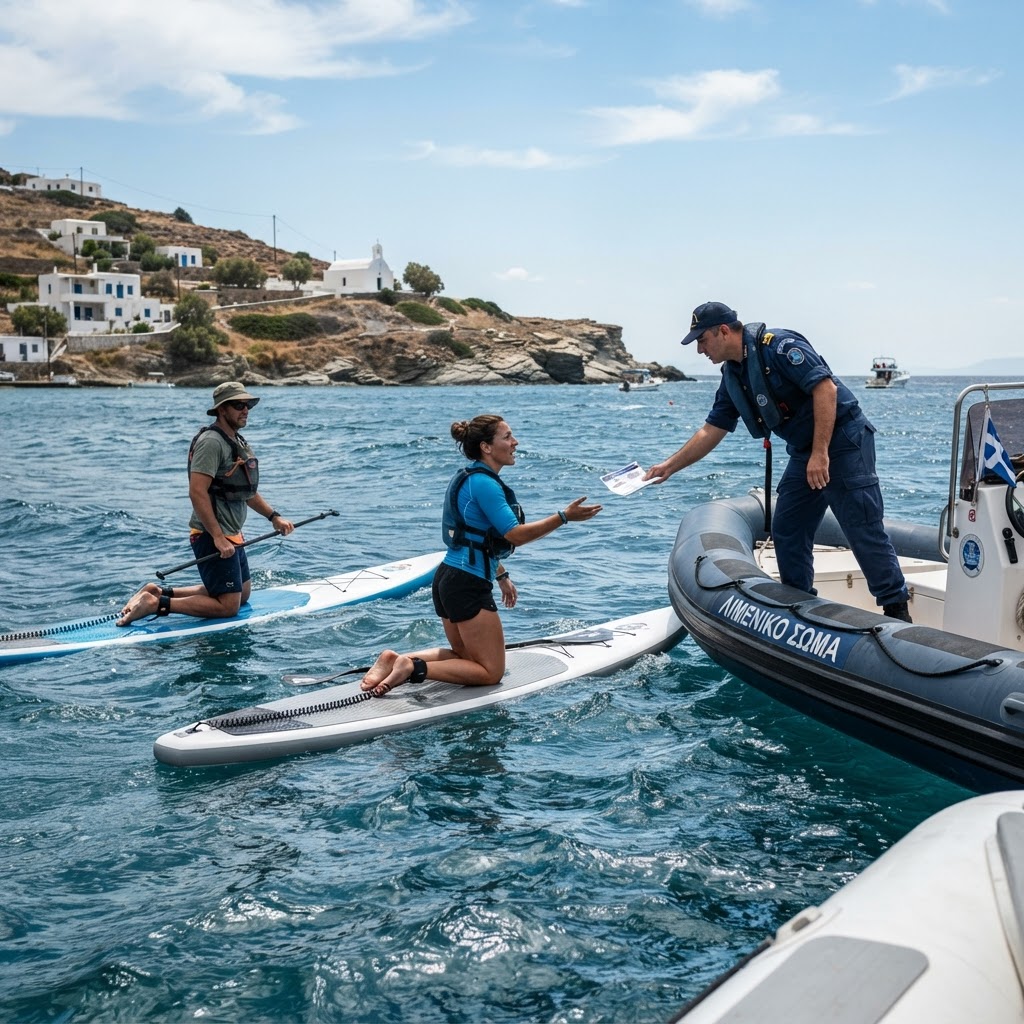
On Monday, 13 July 2026, at Agios Ioannis beach on Lemnos, Hellenic Coast Guard officers spotted a swimmer using a SUP without wearing a personal life jacket. He was asked to return to shore and was issued an administrative fine of €250. The violation was specific: failure to wear the mandatory personal flotation device. The story sparked nationwide debate precisely because thousands of people paddle assuming SUP is a completely "free" activity. Note that the fine was not because SUP is illegal — it isn't — but because a specific safety rule that applies to everyone was not followed.
How the law sees SUP
Here lies the most common misconception. Many equate SUP with swimming or a simple beach toy. In reality, Greek law treats the stand up paddleboard as a marine recreational craft, in the same category as canoes and kayaks — that is, a non-motorized, paddle-powered craft. The key regulatory text is General Port Regulation No. 20, "Speedboats and other marine recreational craft" (Ministerial Decision 3131.1/03/1999, Government Gazette 444/B/1999, as amended and codified). This regulation, together with the local police orders issued by each Port Authority, defines what is and isn't allowed at sea. Because SUP is a regulated activity rather than a lawless zone, Coast Guard checks are entirely lawful.
What applies: the core rules
Mandatory personal life jacket. You must wear — not merely carry — a suitable personal flotation device, regardless of distance from shore, swimming ability or weather. This was exactly the point behind the Lemnos fine.
Swimming ability required. SUP use is prohibited for people who cannot swim.
Age and supervision. The activity is not permitted for young children without supervision; coverage of the rules commonly cites 14 as the threshold. The exact age limit and supervision requirement depend on the local port order, so it's always worth checking with the local Port Authority.
Maximum 500 metres from shore. The board must not go beyond 500 metres from the shoreline.
Daylight only. Use is prohibited before sunrise and after sunset.
Not in adverse weather. Strong wind, waves or sudden weather changes make use unsafe and impermissible.
One person per board. You may not carry more people than the manufacturer specifies — for typical boards, one person.
No conversion to a sailing craft. Fitting a sail/wing or converting the board into a sailing device is prohibited, as it changes the craft's category.
Respect for swimmers. The user must not endanger or disturb other swimmers.
The swimmers' zone
A crucial and often-ignored point is the designated swimmers' zone — the strip near the shore reserved solely for swimming, marked at organized beaches with yellow floating buoys. Within this zone, the movement of any craft is, with few exceptions, prohibited, to protect swimmers. In practice, a SUP user must enter and exit carefully and stay outside the swimmers' area. Where there is no marking, a safe rule of thumb is that swimming stays within roughly 100–200 metres of shore; the board moves beyond the swimmers but always within the 500-metre limit.
What does NOT apply: common myths
"SUP needs nothing, it's like swimming." Wrong — it's a marine recreational craft with specific obligations.
"If I'm a strong swimmer or close to shore, I don't need a life jacket." Wrong — the life jacket is mandatory without exception, as Lemnos showed.
"Having the life jacket on the board is enough." Wrong — you must wear it.
"I can go as far as I can manage." Wrong — the limit is 500 metres.
"I can cruise among the swimmers." Wrong — the swimmers' zone is for swimming; SUP stays outside it.
"There's no law for SUP." Inaccurate — there is no single "SUP law," but the activity is fully regulated through the General Port Regulation and local orders.
The fines
Breaches carry administrative fines imposed by the Coast Guard. In Lemnos the fine was €250 for not wearing a life jacket, an amount also cited as typical for similar breaches (e.g. exceeding 500 metres, using outside daylight hours, or carrying a second person). Beyond SUP, port orders provide fines for other beach activities too — for example dangerous drone use over swimmers or noise pollution — a reminder that the beach is not a free-for-all. Exact amounts can vary by area and by order.
Staying legal and safe: the NOAS way
At the NOAS SUP Academy, following these rules is culture, not obligation. In every session we teach: always wear a life jacket and a leash (the leash keeps the board — your biggest float — close); read the weather before going out (the characteristic wind of the South Euboean Gulf trains our athletes to check wind and sea); respect the swimmers' zone; and stay close to shore and visible, never going out alone in doubtful conditions. Beyond keeping you within the law, these habits are literally the ones that save lives.
Important note
This article is informational and reflects the general framework as it stands at the time of writing (July 2026). Details — age limits, distances, specific prohibitions and fine amounts — may vary by area, since each Port Authority issues its own local orders. Before paddling at a new beach, the safest approach is to check local signage and, if in doubt, ask the local Port Authority. This text is not legal advice.
In closing
SUP is a wonderful, safe and accessible sport — as long as we approach it with respect for the rules and the sea. The Lemnos incident is not a reason for fear but a prompt to get informed: a life jacket, a little attention to distance and to those around us, and the ride stays what it should be — pure enjoyment. At NOAS, in Artemis, we're here to help you learn SUP properly, safely, and with full knowledge of what applies.