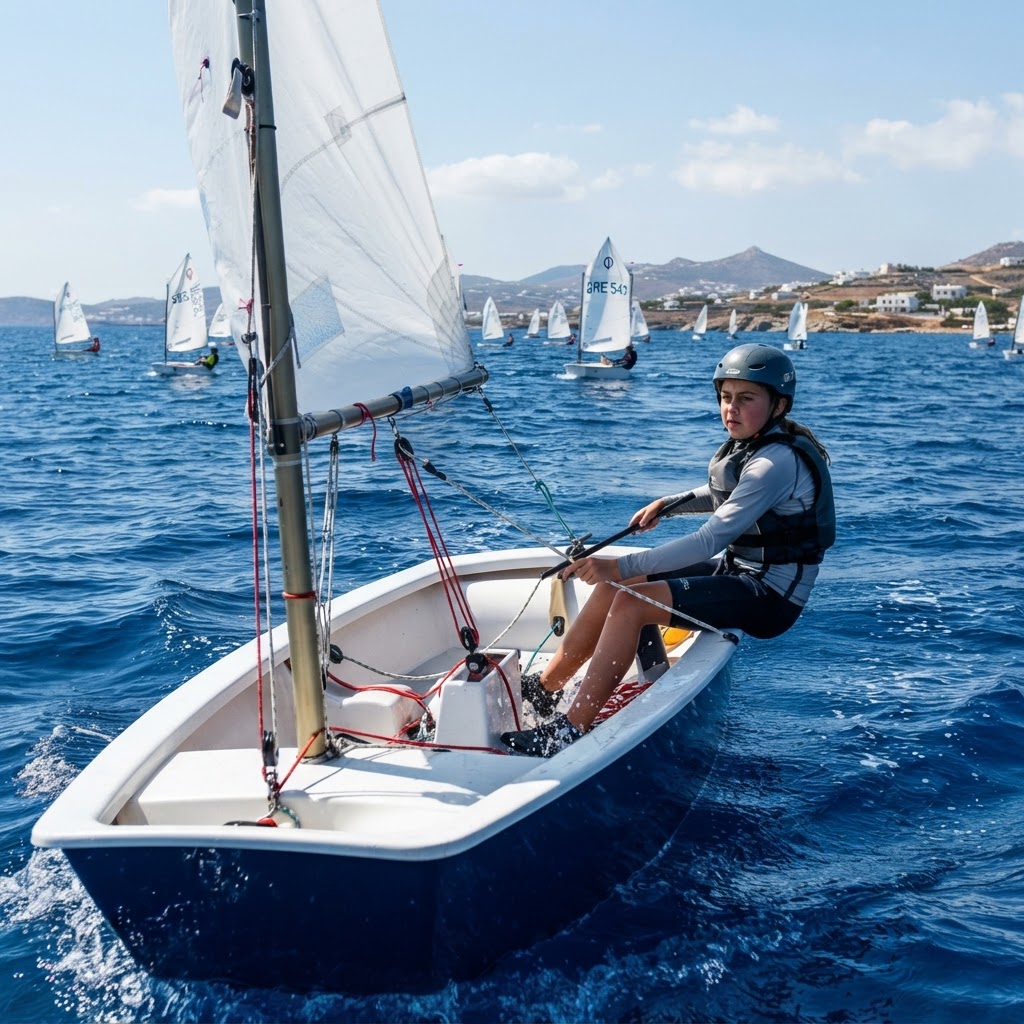
Sailing Psychology: Mastering the Mental Game on the Water
Sailing, particularly in the competitive Optimist class, is far more than a physical test of boat handling and tactical awareness. While the wind, the waves of the South Euboean Gulf, and the precision of your sail trim are critical, there is an invisible component that often dictates the outcome of a regatta: your mental state. Managing pressure in youth sailing is a skill that, once mastered, elevates an athlete from a mere participant to a resilient competitor.
At the Nautical Club of Artemis and Spata (NOAS), we believe that mental strength is a core technical component, just as much as learning to set the sprit or execute a perfect roll tack. As young sailors face the start line, the anxiety of competition can easily cloud their decision-making. Learning how to navigate this pressure is the key to longevity and success in our sport.
Understanding Youth Sailing Anxiety
It is entirely normal for a young athlete to experience pre-race jitters. Anxiety in sailing usually stems from the fear of the unknown—what if the wind shifts? What if I get a bad start? In the unique, sometimes unpredictable environment of the Euboean Gulf, these feelings are amplified. Understanding that this nervousness is simply the body preparing for peak performance is the first step in converting that energy into focus.
Athletes at NOAS are encouraged to view anxiety not as a barrier, but as a physiological signal that they are ready to perform. We emphasize that perfection is not the goal; rather, the focus should be on the process. When a child stops worrying about the result and focuses on the immediate tasks—such as boat speed and clear air—the pressure naturally dissipates.
Strategies for Building Mental Resilience
Resilience is built through consistency and the right coaching philosophy. Developing a "Growth Mindset" is essential. Instead of defining success by a podium finish, we teach our Optimist sailors to value progress. Did you improve your boat speed? Did you handle a difficult gust better than you did yesterday? These small victories build the foundation for a champion's mindset.
Furthermore, visualization is a powerful tool in a young sailor's kit. By mentally rehearsing the race course—the start, the mark rounding, and the finish—a sailor can train their brain to handle pressure before they even step onto the boat. This creates a sense of familiarity, reducing the 'fight or flight' response that leads to hesitation on the water.
The Role of the Environment: Sailing in Artemis
Training at the NOAS facilities provides a unique advantage. The diverse wind conditions of the South Euboean Gulf act as a natural laboratory for resilience. One day, the wind might be light and shifty, testing patience; the next, the waves might be challenging, testing physical and mental endurance. By practicing in these variable conditions, our athletes learn to adapt rather than react. Adaptability is the hallmark of a mentally strong sailor. When a sailor learns that they can solve problems under pressure in the familiar waters of Artemis, they carry that confidence into national and international regattas.
Maintaining Focus Through the Race
Even with the best training, moments of intense pressure occur, especially during the start sequence or at a crowded leeward mark. To manage these, we teach the 'reset' technique. This involves taking a deep, controlled breath and refocusing on the "three-second goal." If the start is botched, don't dwell on it. What is the goal for the next three seconds? Is it to find a lane of clear air? Is it to gain boat speed? By breaking the race down into manageable, bite-sized tasks, the overwhelming pressure of a regatta becomes a series of simple, actionable steps.
The Supportive Role of Parents and Coaches
Pressure is often compounded by external expectations. It is crucial for parents to emphasize that the journey is the reward. At NOAS, we maintain an environment where learning is celebrated above all. When a child knows that their value as a person isn't tied to their race result, they are much more likely to sail with freedom, courage, and true enjoyment. Our coaches work closely with parents to ensure that the sport remains a positive, character-building experience, fostering the passion that keeps a sailor coming back to the water day after day.
Embracing the Challenge
As you develop your skills in the Optimist class, remember that every mistake is a lesson. The pressure you feel is simply the weight of your potential. By practicing mindfulness, focusing on the process, and utilizing the resources provided by the NOAS community, you are not just learning how to race—you are learning how to face challenges with confidence in every aspect of life. If you are ready to take the next step in your sailing journey, we invite you to visit our facilities or contact our secretariat for information on our upcoming programs and trial sessions.