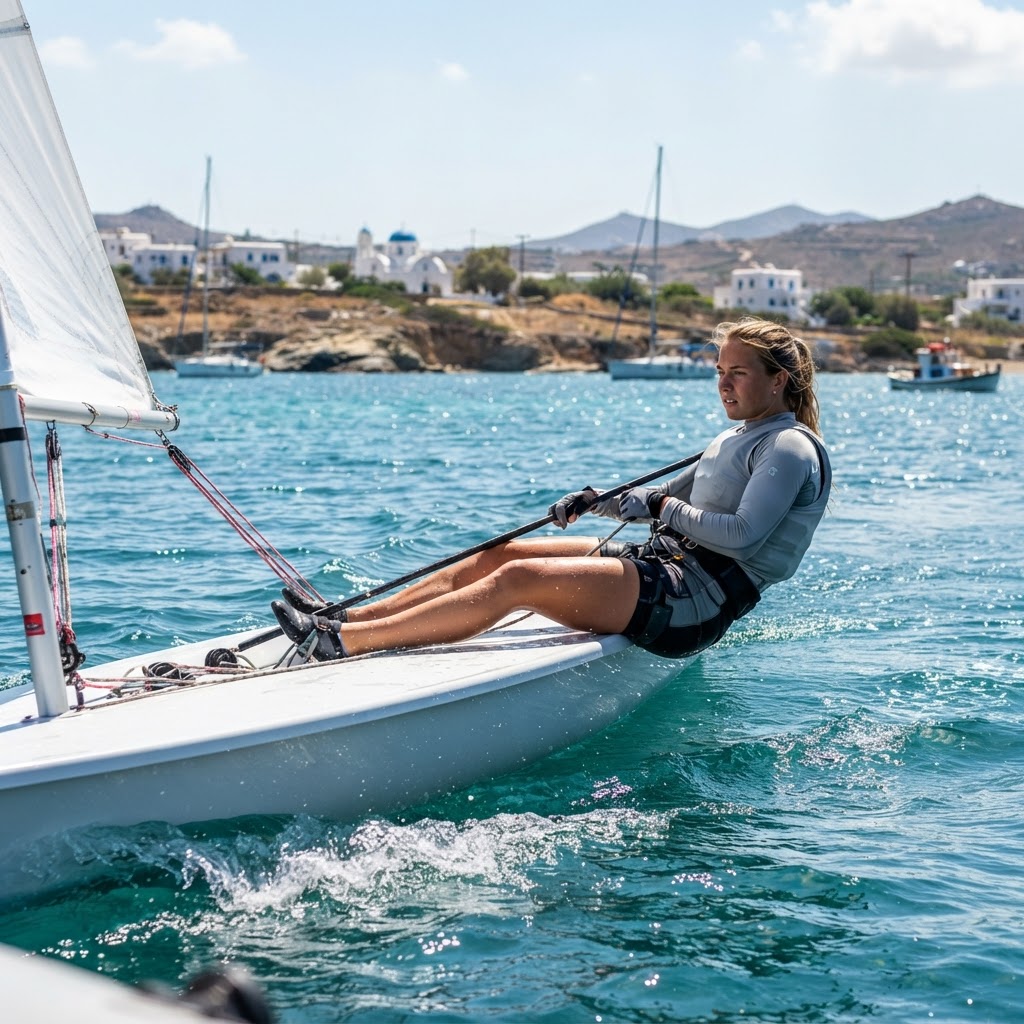
Introduction to the world of ILCA at NOAS
Triangle sailing is one of the most demanding yet thrilling activities a young athlete can choose. Following the completion of the pre-racing and racing Optimist class cycle, the next step for many athletes at the Nautical Athletic Club of Artemis Spata (NOAS) is the transition to the international ILCA class, the well-known former Laser. It is a single-handed boat that is an Olympic class and requires the sailor to possess strategic thinking, excellent physical condition, and the ability to read the weather, especially in the unique conditions of the South Euboean Gulf.
What is the ILCA class and why does it stand out?
The ILCA is a boat designed with simplicity and speed in mind. Its philosophy is one of equal opportunity: the hull (the boat) is identical for everyone, while the difference in the rig allows athletes of different ages and body types to compete under the same specifications. At NOAS, the ILCA Academy focuses on the holistic development of the athlete, offering specialized guidance from the moment the athlete first grips the boom.
ILCA 4, ILCA 6, ILCA 7: Understanding the differences
The main difference between the three types of ILCA lies in the sail area and the length of the bottom section. This differentiation makes the boat scalable, following the athlete's evolution from adolescence to adulthood.
ILCA 4: The first step in adolescence
The ILCA 4 has the smallest sail area (4.7 sq.m.). It is ideal for athletes transitioning from the Optimist. Here, the athlete learns to handle a faster boat without physical strength being the primary obstacle. At NOAS, young sailors learn the fundamental principles of trim and balance, preparing their body and mind for the larger classes.
ILCA 6: The transitional and women's Olympic class
With a 6 sq.m. sail, the ILCA 6 is the class where sailing becomes more technical. It is the Olympic class for women, while for teenagers, it serves as the "stepping stone" before the men's category. This choice requires better technique in roll tacking and greater ability to read the gusts of wind in Artemis.
ILCA 7: The challenge for men
The ILCA 7, with a 7 sq.m. sail, is the category for adult men and older teenage age groups. It requires top physical condition, as the sailor must be able to hike (hang off the side of the boat) for long periods, mastering the force of the wind.
How do we choose the right ILCA?
The choice of rig is not made randomly, but based on the athlete's body weight, experience, and competitive goals. At NOAS, our coaches regularly evaluate the progress of each athlete. Age alone is not enough; the sailor's ability to control the boat under difficult conditions in the South Euboean Gulf is the deciding factor.
The training experience at NOAS
Sailing at NOAS is not limited to theory. ILCA athletes benefit from the area's specific weather. The waters of Artemis offer ideal conditions for "reading" the wind. Training sessions include speed exercises, start simulations, and tactical analysis. Every training session is an opportunity for the athlete to better understand their boat, sail trim, and the importance of correct positioning on the boat.
Tips for athletes
To evolve into a high-level sailor, discipline is key. Studying theory, proper boat maintenance, and physical preparation off the water are just as important as the time spent on the water. Do not hesitate to discuss your goals with your coaches. NOAS is here to provide you with the foundations to excel, whether your goal is local races or the National Championship.
Get started today
If you are ready to take your sailing to the next level or are looking for a new athletic challenge, the NOAS ILCA Academy is waiting for you. Come to get to know the club, see our boats, and talk to our people. The sea of Artemis is the ideal starting point for an exciting sailing journey. Contact the club's secretariat to schedule a visit or to learn about the next trial lesson.