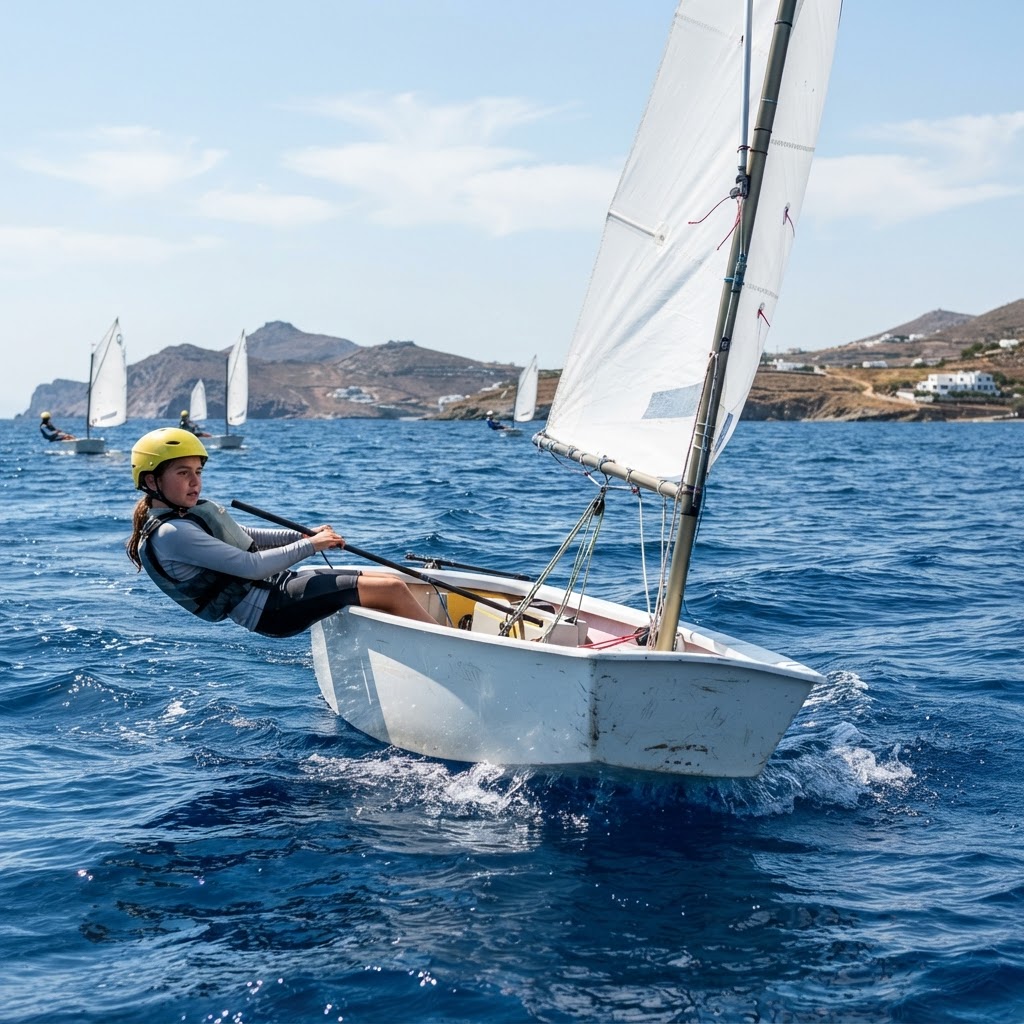
Understanding Hiking: The Engine of Sailing Performance
In the world of dinghy sailing, whether you are an Optimist sailor just starting your journey or an ILCA athlete aiming for the podium, few skills are as fundamental—or as physically demanding—as hiking. At the Nautical Club of Artemis and Spata (NOAS), we emphasize that hiking is not just about leaning out; it is an art form that balances physics, body mechanics, and pure determination. When you are sailing in the beautiful waters of the South Euboean Gulf, understanding how to control the heel of your boat through your own body weight is the primary engine of your performance.
The Physics Behind Sailing Hiking Technique
At its core, hiking is the act of using your body as a counterweight to offset the force of the wind on the sails. In a small boat like an Optimist, the margin for error is minimal. If the boat is not kept flat, the underwater profile of the hull changes, increasing drag and causing the boat to slip sideways rather than driving forward. Proper sailing posture allows the sailor to maintain a flat hull, ensuring that the centerboard provides maximum lift and the sail maintains an efficient aerodynamic shape. As sailors transition to the ILCA class, the intensity of this requirement increases, demanding more core stability and endurance.
Perfecting Your Posture: The Essentials of Optimist Hiking
For our young athletes at NOAS, the journey to becoming a proficient sailor begins with the basics of posture. When hiking, the goal is to get as much weight outboard as possible. Your shins should be locked under the hiking straps, and your body should be angled so that your core is engaged and your back is straight. A common mistake is to 'sit' on the rail with a curved spine; this leads to quick fatigue and poor boat control. Instead, imagine your body as a stiff plank. The power comes from your legs and your abdominal muscles, which act as the bridge between your boat and the sail. By maintaining a clean, consistent angle, you allow the boat to accelerate in gusts rather than stalling under the weight of the sailor.
Training for Endurance: The ILCA Sailing Training Approach
As our sailors grow and move into the ILCA class, the training becomes more specialized. Hiking in an ILCA requires sustained physical effort that can last for hours during a race. Our coaching staff focuses on isometric training and core strength development. It is not enough to simply be able to hold a position for a minute; you must be able to hold it for an entire upwind leg while simultaneously adjusting the mainsheet and reading the wind shifts. We incorporate specific land-based drills to help our athletes build the endurance necessary for the long, challenging races often found in the South Euboean Gulf, where the wind conditions can shift rapidly.
Why Hiking Matters in the South Euboean Gulf
The geography of our home, the South Euboean Gulf, presents unique challenges for young sailors. With varying sea states and wind patterns, the ability to 'feel' the boat through your legs is critical. When the breeze picks up, the difference between a sailor who can hike effectively and one who cannot is immediately visible. The effective hiker keeps the boat fast and stable, allowing them to focus on tactics and strategy rather than struggling to keep the boat upright. Mastering your technique here in Artemis gives you a competitive advantage that will serve you well in any regatta, whether local or national.
Consistency and Practice: Building the Habit
At NOAS, we believe that technique is developed through repetition and conscious practice. During our weekly training sessions, our coaches observe every sailor, offering real-time feedback on their hiking posture. We encourage our athletes to focus on 'hiking days'—specific sessions where the primary objective is to maintain perfect form, even when the wind is light. By developing the muscle memory early on, our sailors find that hiking becomes second nature, allowing them to dedicate more mental energy to their racing tactics and overall boat speed.
Join Our Community at NOAS
Are you ready to take your sailing to the next level? Whether you are a beginner looking to understand the fundamentals in an Optimist or an experienced sailor looking to refine your technique in an ILCA, the Nautical Club of Artemis and Spata offers a supportive and expert environment. We invite you to visit our facilities, meet our coaching staff, and learn more about our training programs. Our doors are always open to those who wish to master the waves and become part of our growing sailing family. Contact our secretariat today to book a trial session and experience the thrill of the Euboean Gulf for yourself.