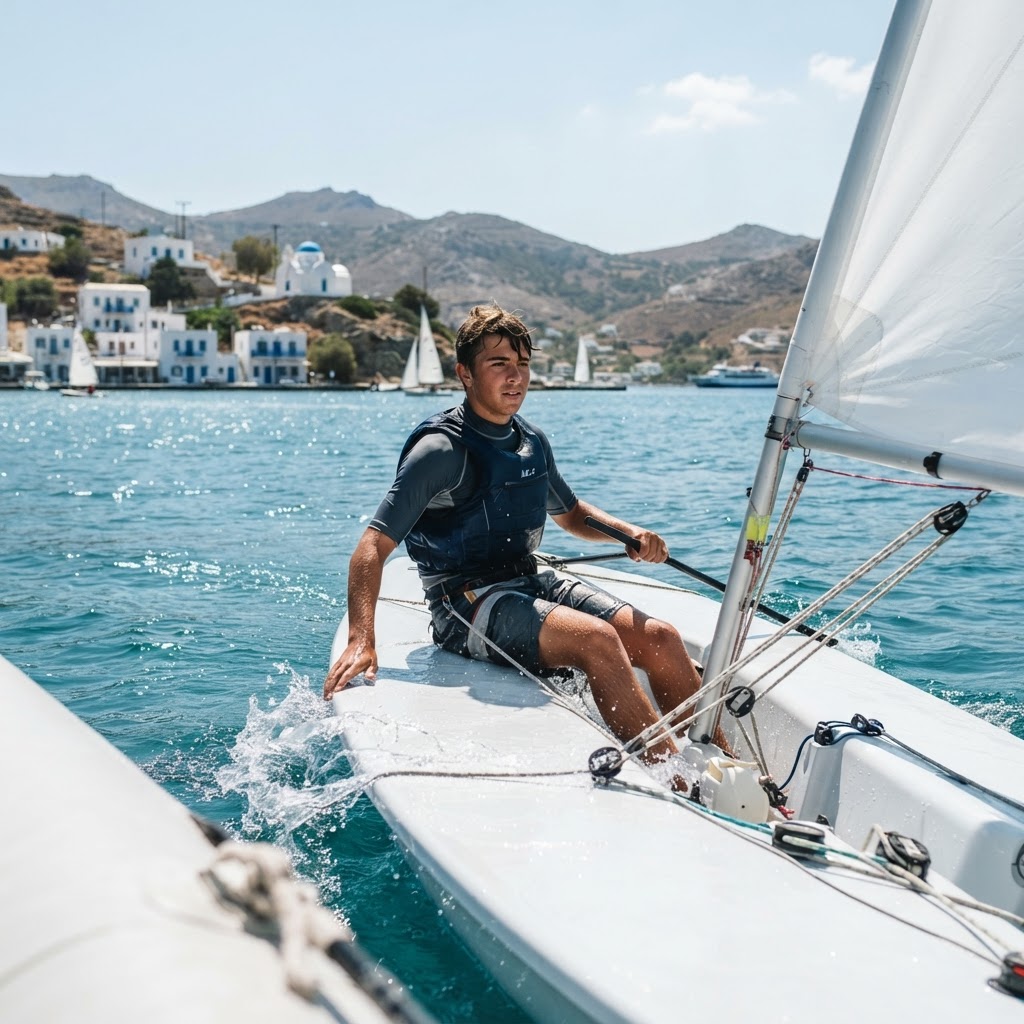
The transition from Optimist to ILCA: A new era for the athlete
Completing your cycle in the Optimist marks an exciting turning point in the journey of every young sailor. At the Nautical Club of Artemis Spata (NOAS), we have seen dozens of our athletes take the big step toward the ILCA (formerly Laser) category. This transition is not just a boat change; it is a shift from the world of youth sailing to the world of high performance, the Olympic class, and technical maturity. In the waters of the South Euboean Gulf, with its unique and demanding conditions, the NOAS ILCA Academy offers the ideal environment for this evolution.
What makes the ILCA the natural next step?
The ILCA is the most widely used single-handed sailing boat in the world. Unlike the Optimist, the ILCA requires the athlete to manage a larger sail area, different weight distribution, and a more complex rigging structure. When an athlete steps into an ILCA, they learn to read the waves with greater precision, understand speed dynamics, and adapt their body to the balance requirements of a boat that responds immediately to every movement. Our Academy focuses on the proper mastery of sail trim, body technique, and strategic thinking.
ILCA 4, ILCA 6, and ILCA 7: Understanding the rigs
One of the most frequent questions we receive at the club's office concerns age groups and sizes. The "magic" of the ILCA is the system of different rigs (masts and sails). The ILCA 4 is the introductory boat, suitable for athletes coming from the Optimist. It is designed for young sailors, allowing them to learn the fundamental principles of control before moving on to a larger sail area. The ILCA 6 is the Olympic boat for women and the next stage for teenagers, while the ILCA 7 is the Olympic boat for men, requiring a high level of physical fitness and strength.
Training at NOAS: From theory to practice
At NOAS, our philosophy is that the athlete must understand the "why" behind every setting. Within our Academy, we place emphasis on understanding meteorology and the specific winds of Artemis. Training includes tactical sessions aimed at improving technique in starts, racing, and boat tactics. Our coaches are by the side of every athlete, helping them build the confidence needed to compete at a high level.
Why choose NOAS for your ILCA journey?
Our location on the South Euboean Gulf offers a unique training field. The variation in conditions, from light breezes to stronger winds, prepares the athlete for any challenge at a national and international level. Furthermore, the atmosphere at our club is familiar yet focused on excellence. Whether your goal is to participate in national championships or simply enjoy the sport at a high technical level, NOAS provides the support network required.
How does the journey begin?
The transition requires patience and consistency. We invite you to contact our office to get information about the ILCA Academy program, boat availability, and the trial lesson process. Whether you are an athlete completing your cycle in the Optimist or an adult wishing to be initiated into the charm of Olympic sailing, at NOAS you will find the guidance you seek. Come meet our fleet up close, talk to our coaches, and become part of our sailing community in Artemis.
Sailing in the ILCA is a journey of continuous learning. Every time you head out onto the waters of the South Euboean Gulf, you are not just improving your skills on the boat, but building character, discipline, and a deep connection with the sea that will follow you for a lifetime. We look forward to seeing you at NOAS!